

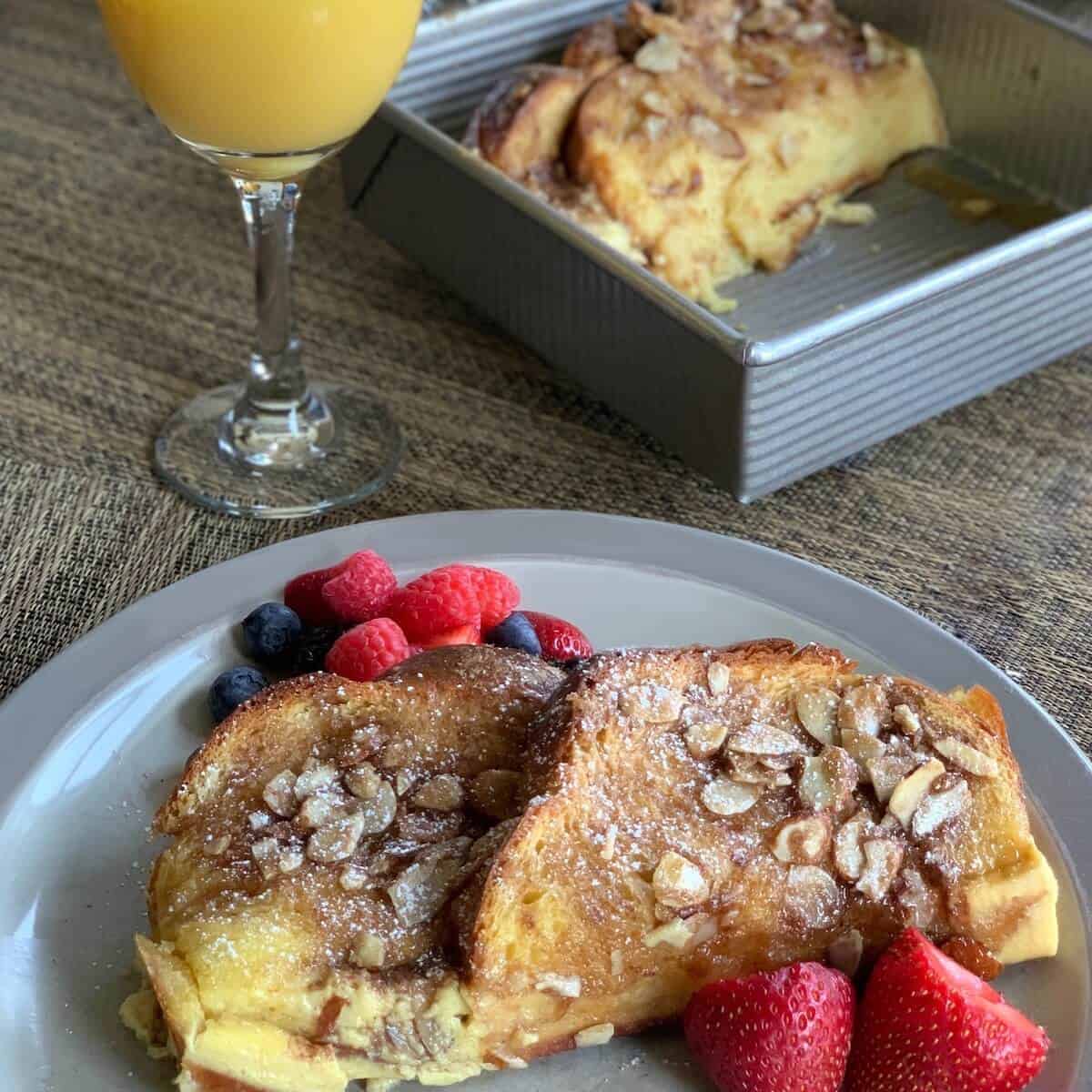
This overnight challah French toast casserole soaks slices of rich bread in a silky custard, then bakes beneath a buttery cinnamon amandine streusel with crisp toasted almonds and buttery cinnamon sugar in every bite. Assemble it the night before and wake up to an easy, bakery-worthy brunch with almost no morning effort!
Jump to:
Quick Recipe Summary ✨
Overnight Challah French Toast Casserole with Cinnamon Amandine Streusel: Thick slices of challah soak overnight in a rich vanilla custard, then bake up golden and fluffy beneath a buttery cinnamon streusel loaded with toasted sliced almonds. It's an easy make-ahead brunch that feels bakery special.
Amandine-inspired topping: Instead of plain cinnamon sugar, a buttery almond streusel spiked with cinnamon adds crisp texture and nutty flavor to balance the soft, custardy center.
Built for stress-free mornings: Assemble everything the night before so the bread fully absorbs the custard, then simply bake and serve!
Texture done right: A balanced custard ratio creates a silky interior (not soggy, not rubbery), while the streusel keeps every bite from feeling too soft.
Active Time: About 25 minutes • Chill Time: 1 hour to overnight • Bake Time: 30 to 35 minutes • Total Time: About 2 to 14 hours (mostly hands-off!)
Difficulty Level: ⭐⭐ Easy. Straightforward assembly with a few little tricks for extra creamy custard and crisp topping.
Yield: 8 servings • Freezer-friendly: Up to 3 months • Make-ahead: Assemble up to 24 hours ahead
👉 Follow the detailed instructions and troubleshooting tips below to make overnight challah French toast casserole with a fluffy custard, crunchy cinnamon almond topping, and no last-minute brunch scrambling.
SUMMARIZE & SAVE THIS CONTENT ON
Why this recipe works
- Challah holds up beautifully: Rich and tender, but sturdy enough to soak overnight without falling apart.
- The overnight rest improves every bite: More soak time means creamy custard all the way through with no dry pockets.
- The cinnamon amandine streusel adds crunch: Toasted almonds and buttery cinnamon sugar balance the soft custard.
- The custard ratio keeps the texture right: Silky and fluffy instead of soggy or rubbery.
- The optional water bath bakes gently: It helps the custard set evenly from edge to center.
Doesn't brunch make any day special? Whether it's Mother's Day, Father's Day, Christmas mornings, bridal and baby showers, or any other let's-have-a-leisurely-morning, brunch invites lingering over the meal with extra special foods.
Quiches (with and without a crust), cinnamon rolls, and babka are obvious choices for a brunch meal, but the granddaddy of them all is french toast.
And while you can soak a piece of bread in egg and slap it on a griddle, making a baked french toast casserole allows for more creativity, especially when you make an overnight french toast that you just pop into the oven the next morning.
So let's make a challah french toast casserole topped with a buttery cinnamon sugar and sliced almonds streusel. And you can do to most of the work the night before - just heat the oven and bake. No mess or stress right before serving!
This baked French toast casserole recipe is incredible. The custard has a rich taste and silky mouthfeel, and the bread is light and crunchy from the streusel and almonds, but not overly sweet.
Friends, this overnight challah French toast casserole wins brunch!
Recipe Ingredients
You'll need the following ingredients to make this recipe:
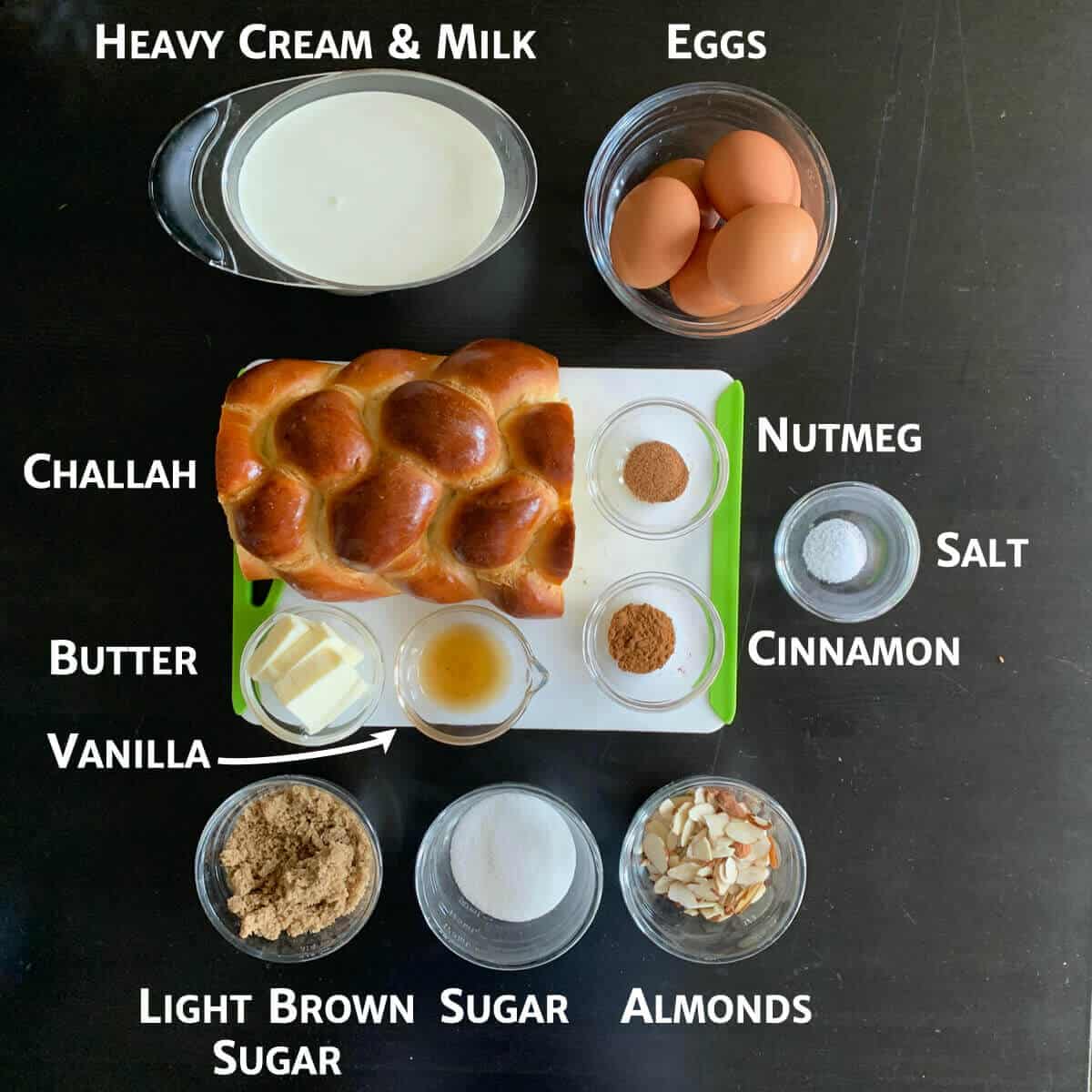
Ingredient Notes
A french toast bake is really just another version of baked bread pudding. It's bread soaked in an egg custard (generally with other flavorings), then baked to set the custard. So this dish can be called a French toast bread pudding, a baked French toast casserole, a French toast bake, or just bread pudding. They're all interchangeable.
Milk: You can use any type of milk you'd like in the custard. Dairy milk (from fat free to whole milk), almond milk, soy milk, oat milk...you name it, it's fine.
Want to reduce or omit the amount of heavy cream in the custard? Just increase the milk (or milk alternative) you're using by the same amount. The only difference will be in the custard's richness.
Eggs: The bread pudding custard is made from a recipe ratio of 2 : 1, that is, 2 parts liquid (in this case milk and cream) to one part beaten eggs by weight. This ratio gives you enough body for the custard to hold up the fillings with a silky mouthfeel that isn't rubbery or stiff.
Generally speaking, a large egg can be anywhere from about 1½ to 2 ounces (about 45 to 57 grams). It's important to weigh your eggs when possible so you'll know how much liquid to use (having a kitchen scale helps). Without a scale, if 5 large eggs are assumed to be about 1½ ounces (45 grams), using 2 cups of liquid should be about right.
Bread: You can choose the bread to use, usually challah (egg bread), brioche, or even babka. A french toast casserole recipe is a great way to use up stale bread, so that's a win.
Flavorings: Like with bread pudding, you can flavor this baked French toast how you like with different spices and mix-ins. Add chopped dried or fresh fruit or toss in chopped nuts or chocolate chips. The possibilities are endless!
See recipe card for a full list of ingredients and measurements.
How to make overnight baked French toast casserole
While you can use a store bought challah or brioche, this is the best recipe for homemade challah around, especially if you make it as a 4- or 6-strand braid (or even 8-strand!). If possible, make it two days before you plan to bake the French toast bake to give it a chance to stale for a day.
Step 1: Slice the bread
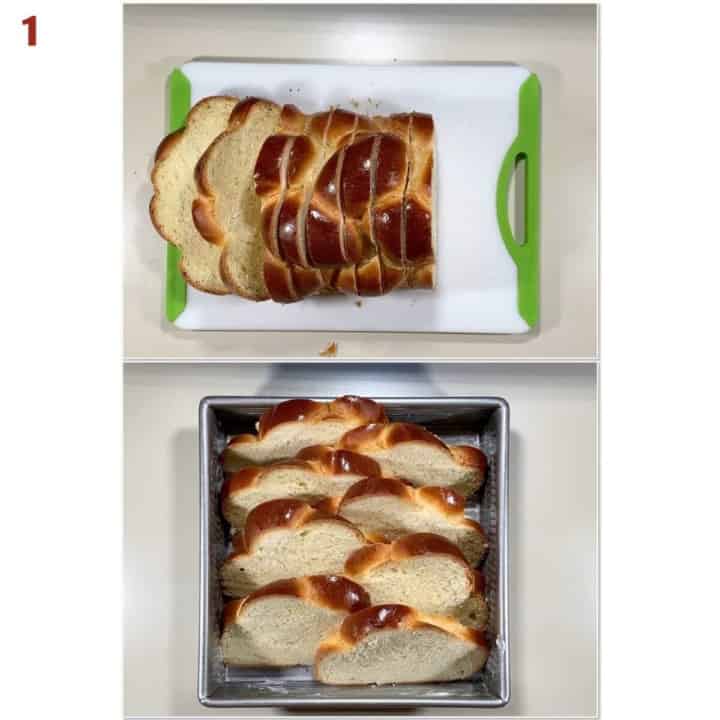
Cut the bread across into eight ¾-inch slices. If you are not using a braided challah bread, cut the slices into two triangles each.
Arrange the bread slices in a generously buttered 8- x 8-inch baking pan in a side-to-side pattern (like scallops), leaning and overlapping them (photo 1).
Step 2: Make the custard
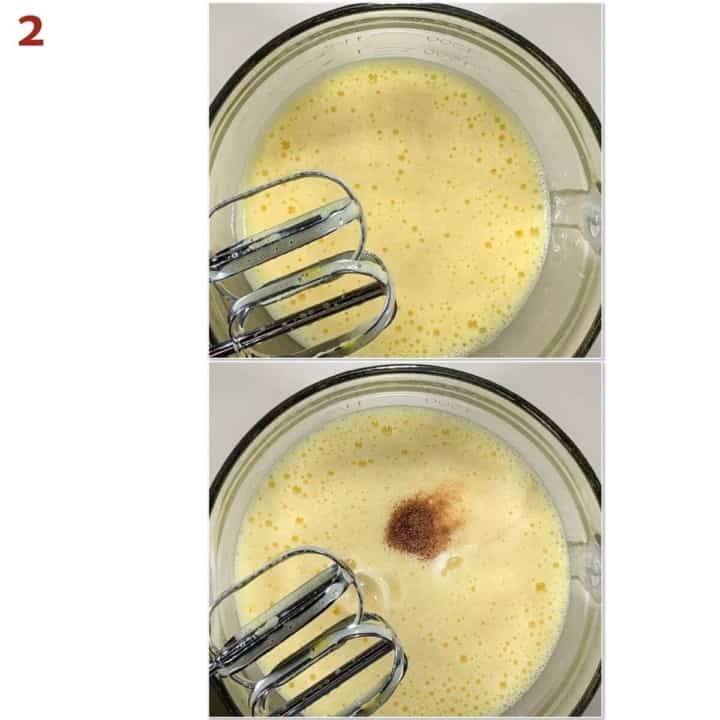
In a medium bowl (preferably one with a spout for easy pouring), use a hand mixer to beat the eggs on high until light golden and slightly thickened, about 3 minutes. Beat in the cream, milk, granulated sugar, vanilla extract, salt, and nutmeg (photo 2).
Beat the eggs well for better custard texture
The trick to making custard is to beat the eggs until they're nice and frothy. Beating the eggs well adds air, leading to a puffier soufflé with a lighter texture.
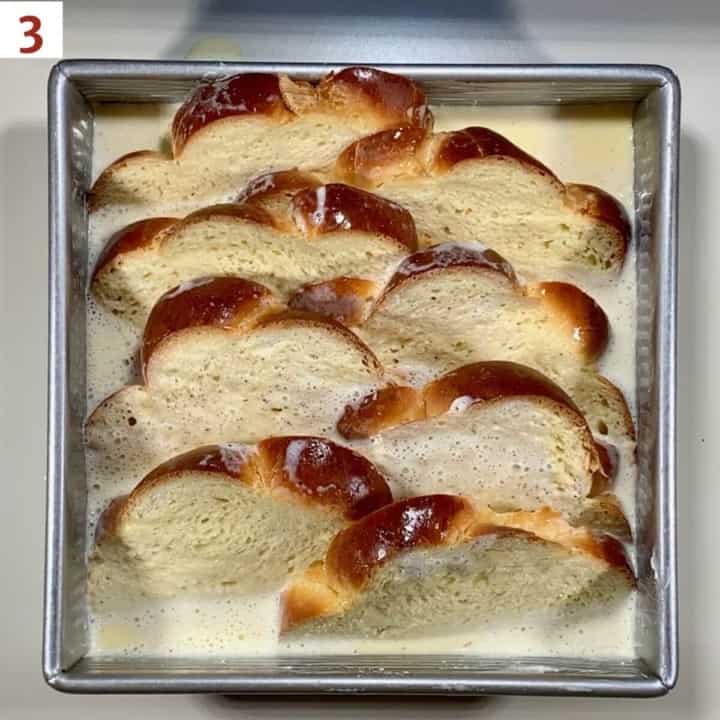
Pour the custard over the bread in the dish, lifting the bread up slightly to pour between the slices and letting the custard soak in (photo 3). It may seem like you have too much, but go slowly to allow the bread time to absorb the custard.
Step 3: Make the almandine streusel
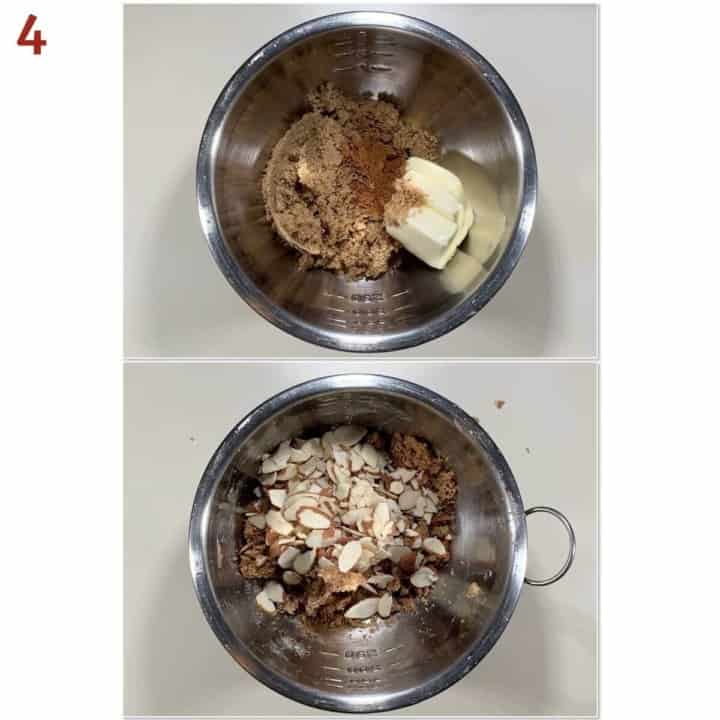
Using a pastry blender or two knives, combine the brown sugar, butter, and cinnamon to form a loose mixture. Fold in the almond slices (photo 4).
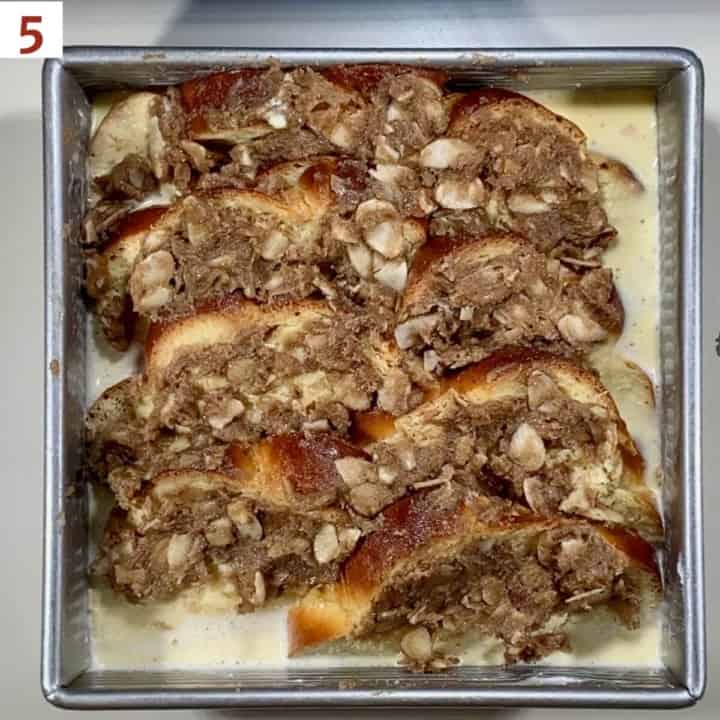
Use your hands to spread the streusel mixture over the top of the soaked challah and in between the slices (photo 5).
Cover the dish with plastic wrap and refrigerate for at least 1 hour or overnight to allow the bread to soak up the custard.
If chilling overnight, remove the pan from the refrigerator an hour before baking to allow the eggs to come to room temperature. Remove the plastic wrap and drizzle the maple syrup over the top.
Step 4: Bake the casserole
Don't preheat the oven yet if you're using a water bath.
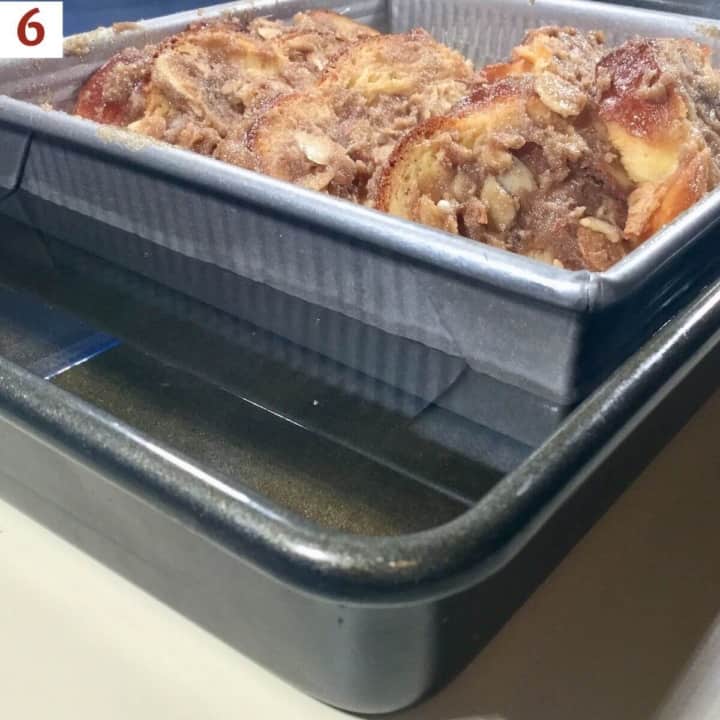
To make a water bath, place the baking pan in the center of a 9- x 13-inch baking pan. Pour about 4 cups of water into the pan. It should reach about 1-inch up the side of the smaller baking pan (photo 6).
Remove the smaller pan and carefully transfer the larger pan to the cool oven. The water will warm in the larger baking pan as the oven preheats.
When the oven is ready, carefully place the casserole into the water bath (be careful opening the oven because you can get a blast of steam in your face).
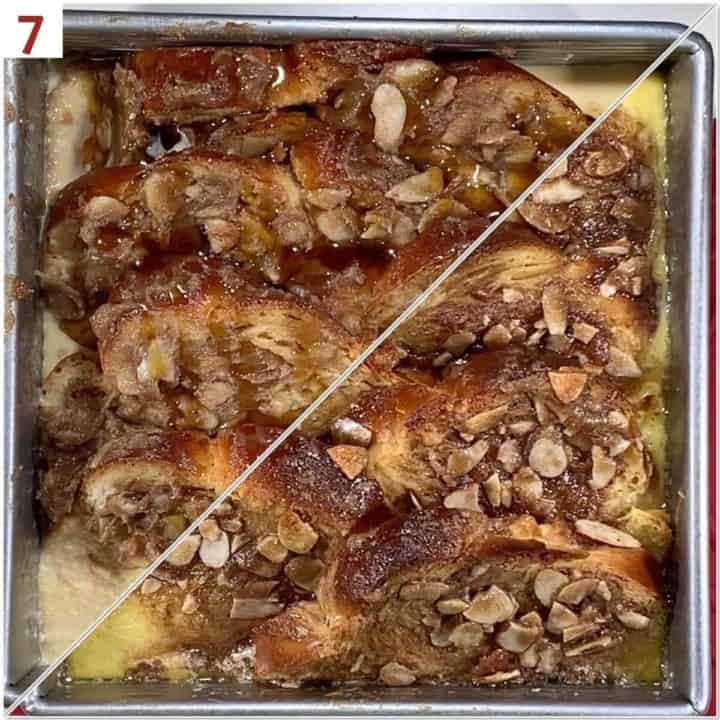
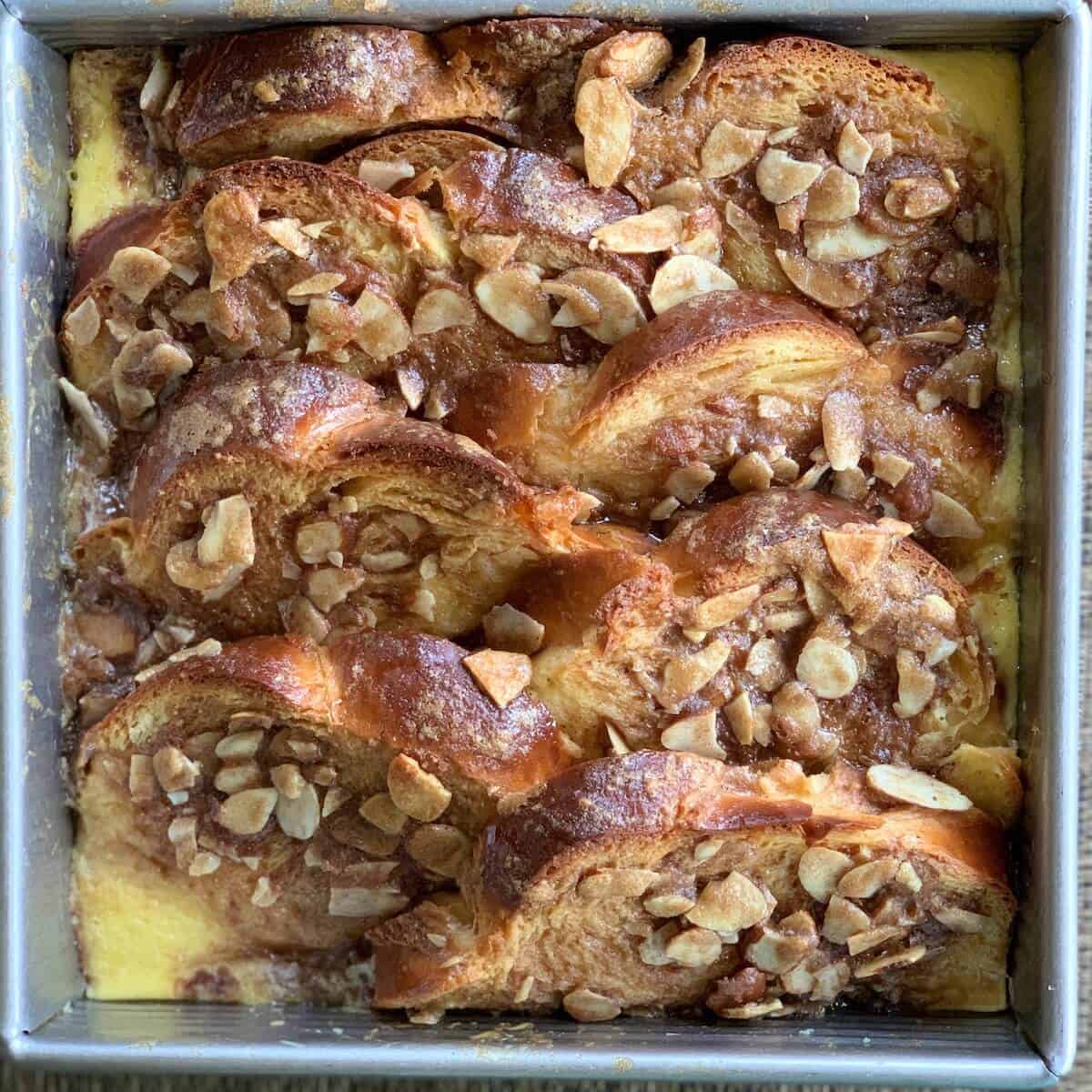
Bake the French toast at 350°F until the custard is puffy and golden brown, about 30 to 35 minutes (photo 7). The top should be spongy (not dry or crusty), and not too brown.
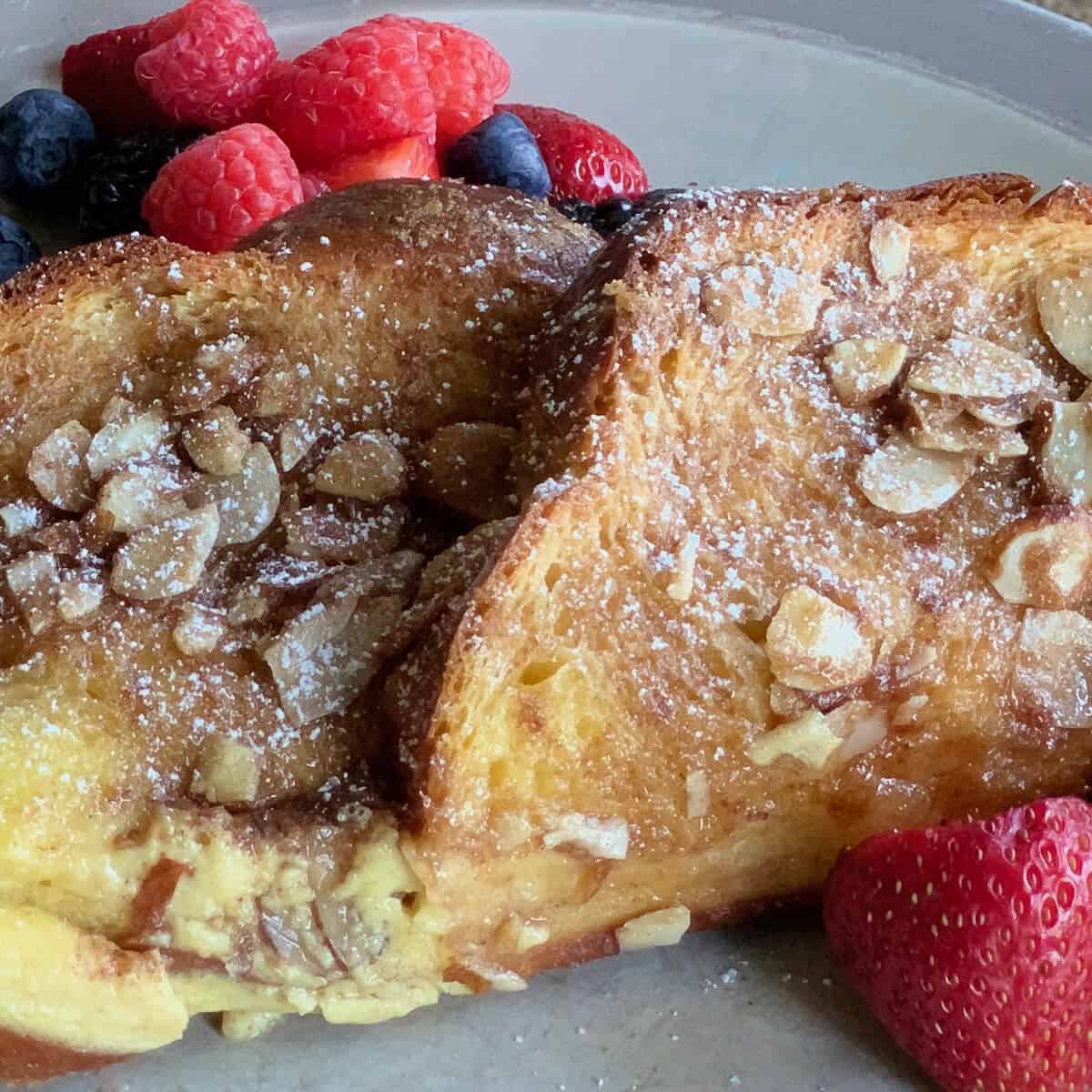
Serve the French toast piping hot, right out of the oven. Dust with powdered sugar, if desired.
Storage instructions
The cooled casserole can be stored in the refrigerator, rightly wrapped, for 2 to 3 days. Reheat until warmed.
For longer storage, freeze in an airtight container and for 2 to 3 months. Thaw overnight in the refrigerator before reheating.
Yield Notes
This french toast bread pudding recipe makes eight good-sized portions. You can double the recipe using 9- x 13-inch baking pan and add about 5 to 10 minutes onto the baking time. It's best if you have a larger pan available for the water bath.
Otherwise, place a large roasting pan filled halfway with water on the rack beneath your casserole dish like I did when making this cheesecake recipe.
Choose your French toast style
You do have options when making French toast. You can affect the final outcome using the following guidelines:
- Custardy & soufflé-like: Bake in water bath + overnight soak
- Soft center + crisp top: Overnight soak, no water bath
- Crunchier edges: Bake uncovered + extra streusel
- More bread pudding texture: Use thicker slices
Your bread choices matter as well:
| Bread | Texture | Best For |
| Challah | Rich + tender | Best overall |
| Brioche | Buttery + soft | Dessert brunch |
| Babka | Swirled + sweet | Special occasions |
| French bread | Firmer | Less rich |
Questions asked and answered
Here are some questions you might have...
The answer lies with the custard's recipe ratio of liquid to eggs. That 2 : 1 liquid to egg ratio (two parts liquid to one part beaten eggs) is by weight. Generally speaking, a large egg can be anywhere from about 1½ to 2 ounces (about 45 to 57 grams). It's important to weigh your eggs when possible so you'll know how much liquid to use (having a kitchen scale helps). Without a scale, if 5 large eggs are assumed to be about 1½ ounces (45 grams), using 2 cups of liquid should be about right.
If the french toast bread pudding is soggy, that probably means you had too much liquid in the custard mixture for the amount of eggs used. You can try baking the casserole a little longer to see if that helps the custard to set.
Like with the soggy casserole, a rubbery custard means that you have too much egg in the custard mixture for the amount of liquid used. If your large eggs are closer to 2 ounces (57 grams), then for 5 eggs you'd need 2¼ cups (280 grams) of liquid.
To solve this problem, reduce the amount of eggs used next time, and make sure not to over-bake the casserole. Take the pan out of the oven just when the custard is just set and jiggles slightly in the middle.
That's a good question. The answer is...it depends. Strictly speaking, a water bath is helpful, but not required.
What is the water bath for then, you might ask? It protects the custard from over-baking on the outside while the inside sets so it cooks evenly. You can skip the water bath and have good results, just keep a careful eye that the custard isn't overcooking and the middle is set.
I recommend measuring the water into your larger pan with the smaller pan placed inside using room temperature tap water. The water should come about one-inch below the top of the smaller pan. Remove the smaller pan and place the water bath in the oven just before you preheat it. The preheating oven warms the water. Just be careful...you'll get a face full of steam when you open the oven door.
In this context, it's a French culinary term indicating the dish is garnished with almonds, often cooked with butter and other seasonings.
Didn't find the answer you're looking for?
Ask AI to answer for this specific recipe:
Disclaimer: I am not responsible for the quality of AI information

I hope you like this recipe! Let me know if you have any questions, and don't forget to leave a comment and rating. Thanks!
Slainté! L'chaim! Cheers!
- Tammy

Recipe
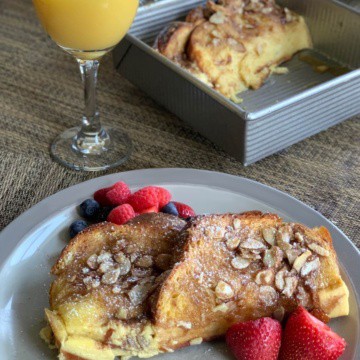
Overnight Challah French Toast Casserole with Amandine Streusel
Equipment
- hand mixer
Ingredients
- homemade challah, or store bought, see Recipe Notes
For the custard
- 5 large eggs, at room temperature
- 1 cup heavy cream, at room temperature, see Recipe Notes
- 1 cup milk, at room temperature, see Recipe Notes
- ¼ cup granulated sugar
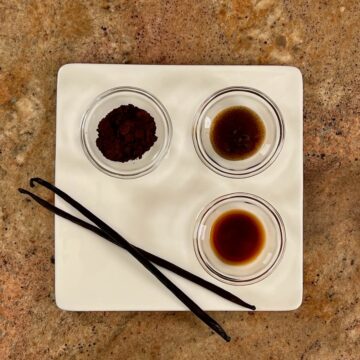
- 2 teaspoons pure vanilla extract
- ¼ teaspoon kosher salt
- ¼ teaspoon ground nutmeg, see Recipe Notes
For the almandine streusel
- ⅓ cup dark brown sugar, packed
- ¼ cup unsalted butter, softened
- ½ teaspoon ground cinnamon
- ⅓ cup almonds, sliced
To finish
- 3 tablespoons pure maple syrup, for drizzling
- powdered sugar, for dusting (optional)
Instructions
- Generously butter a 8- x 8-inch baking pan. Set aside.
- Cut homemade challah across into eight ¾-inch slices. If you are not using a braided challah bread, cut the slices into two triangles each.
- Arrange the bread slices in the pan in a side-to-side pattern (like scallops), leaning and overlapping them.
- Make the custard: In a medium bowl (preferably one with a spout for easy pouring), use a hand mixer to beat 5 large eggs on high until light golden and slightly thickened, about 3 minutes. The trick to making custard is to beat the eggs until they're nice and frothy. Beating the eggs well adds air, leading to a puffier soufflé with a lighter texture.
- Beat in 1 cup heavy cream, 1 cup milk, ¼ cup granulated sugar, 2 teaspoons pure vanilla extract, ¼ teaspoon kosher salt, and ¼ teaspoon ground nutmeg.
- Pour the custard over the bread in the dish, lifting the bread up slightly to pour between the slices and letting the custard soak in. It may seem like you have too much, but go slowly to allow the bread time to absorb the custard.
- Make the almandine streusel: Using a pastry blender or two knives, combine the ⅓ cup dark brown sugar, ¼ cup unsalted butter, and ½ teaspoon ground cinnamon to form a loose mixture. Fold in ⅓ cup almonds (sliced).
- Use your hands to spread the streusel mixture over the top of the soaked challah and in between the slices. Cover the dish with plastic wrap and refrigerate for at least 1 hour or overnight to allow the bread to soak up the custard.
- If chilling overnight, remove the pan from the refrigerator an hour before baking to allow the eggs to come to room temperature. Remove the plastic wrap and drizzle 3 tablespoons pure maple syrup over the top.
- Prepare the water bath: Place the baking pan in the center of a 9- x 13-inch baking pan. Pour about 4 cups of water into the pan. It should reach about 1-inch up the side of the smaller baking pan. Remove the smaller pan and carefully transfer the larger pan to the oven. The water will warm in the baking dish as the oven preheats.
- Preheat the oven to 350 °F. Allow the oven to heat 15 to 30 minutes past the point it indicates it's preheated (this eliminates hot spots and helps even baking).
- Carefully place the casserole into the water bath. Bake until the custard is puffy and golden brown, about 30 to 35 minutes. The top should be spongy (not dry or crusty), and not too brown.
- Serve the french toast piping hot, right out of the oven. Dust with powdered sugar, if desired.
- Storage instruction: The cooled casserole can be stored in the refrigerator, rightly wrapped, for 2 to 3 days. Reheat until warmed.For longer storage, freeze in an airtight container and for 2 to 3 months. Thaw overnight in the refrigerator before reheating.
- You can double the recipe using 9- x 13-inch baking pan and add about 5 to 10 minutes onto the baking time. It's best if you have a larger pan available for the water bath.




Comments
No Comments