

This Butterscotch Pie has a rich, buttery brown sugar filling baked in a flaky pie crust until creamy yet sliceable, much like a Southern chess pie. Made without flour or cornstarch, this easy homemade pie delivers deep butterscotch flavor with hints of caramel and molasses in every bite!

Jump to:
Quick Recipe Summary ✨
Homemade Butterscotch Pie: A flaky pie crust filled with a rich baked butterscotch custard made with brown sugar, butter, cream, eggs, and vanilla. The filling is creamy yet sliceable, similar to a Southern chess pie.
Easy from-scratch filling: No cornstarch, flour, or separating eggs - just cook the butterscotch base, whisk in the eggs, and bake until softly set.
Active Time: about 20 minutes • Bake Time: about 45 minutes • Total Time: about 2½ hours, including cooling
Difficulty Level: ⭐⭐ Easy. The filling is simple to make; par-baking the crust helps keep it crisp.
Yield: 6 slices from a 7-inch pie • Full-size option: Double the filling for a 9-inch pie • Make-ahead: Bake and refrigerate until ready to serve.
👉 Follow the step-by-step instructions and troubleshooting tips below for a rich, creamy Butterscotch Pie with a flaky crust and perfectly set filling every time!
SUMMARIZE & SAVE THIS CONTENT ON
Why this recipe works
- Deep butterscotch flavor: Cooking brown sugar with butter brings out its caramel and molasses notes
- Balanced richness: A little salt and plenty of vanilla round out the buttery brown sugar filling
- Crisper bottom crust: Par-baking gives the pastry a head start before adding the wet filling
- Flavor your way: Light or dark brown sugar lets you choose how pronounced the molasses notes will be
I love making custard-based pies a little off the beaten path. Sure Chocolate Cream Pie and Pecan Pie are fabulous, let's shine the spotlight on another exceptional candidate, Butterscotch Pie!
Butterscotch pie starts with the classic flavors of butter and brown sugar, but the filling can take different forms. Some versions are stovetop butterscotch pudding or cream pies thickened with flour or cornstarch, often topped with meringue.
This version uses whole eggs to set the filling as it bakes, giving it a creamy but sliceable texture similar to a chess pie. It's essentially a butterscotch sauce that's set with eggs as it bakes. If you were to omit the eggs, you'd have a delicious sauce to pour over ice cream!
Butterscotch Pie is quite delicious - think buttery caramel combined with undertones of molasses. A whipped cream topping adds to the creaminess, and the whole thing is complemented by the flaky pie crust.
Take a step off the beaten path and try making this easy Butterscotch Pie. And while you're there, check out Southern Brown Sugar Pie and Shoofly Pie - two more super-flavorful pies that deserve your attention!
⭐⭐⭐⭐⭐
My family and I LOVE pie. I want to be able to bake new pies more often, but without the guilt of eating leftover pie for days. I recently inherited 7-inch pie pans, so I'll be able to make my dreams come true. Thanks for doing the conversion work for me!
- Nicole
Recipe Ingredients
You'll need the following ingredients to make this butterscotch pie recipe:

Ingredient Notes
This easy filling uses basic ingredients: butter, brown sugar, salt, heavy cream, eggs, and vanilla extract.
Brown Sugar: Either light or dark brown sugar works. Light brown sugar gives the pie a milder caramel flavor, while dark brown sugar adds deeper molasses notes.
Eggs: Whole eggs set the butterscotch filling as it bakes, so there's no need for flour or cornstarch.
Pie crust: You can make a homemade pie crust (I prefer my flaky all butter pie crust) or use a store-bought crust.
See the recipe card for a full list of ingredients and measurements.
How to make Butterscotch Pie
Step 1: Prepare the pie crust
Prepare a half recipe of a double pie crust (see the Pie Dough Scaling section below).
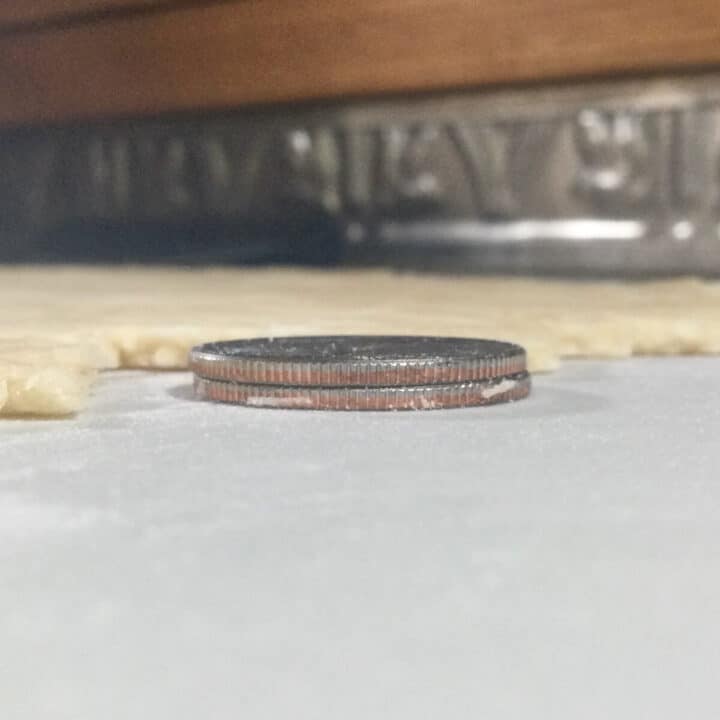
How thick should pie dough be?
Roll pie dough about ¼-inch thick for a standard pie, about the height of two stacked quarters.
For a smaller 7-inch pie, aim for ⅛- to ¼-inch so the crust stays proportional to the filling.
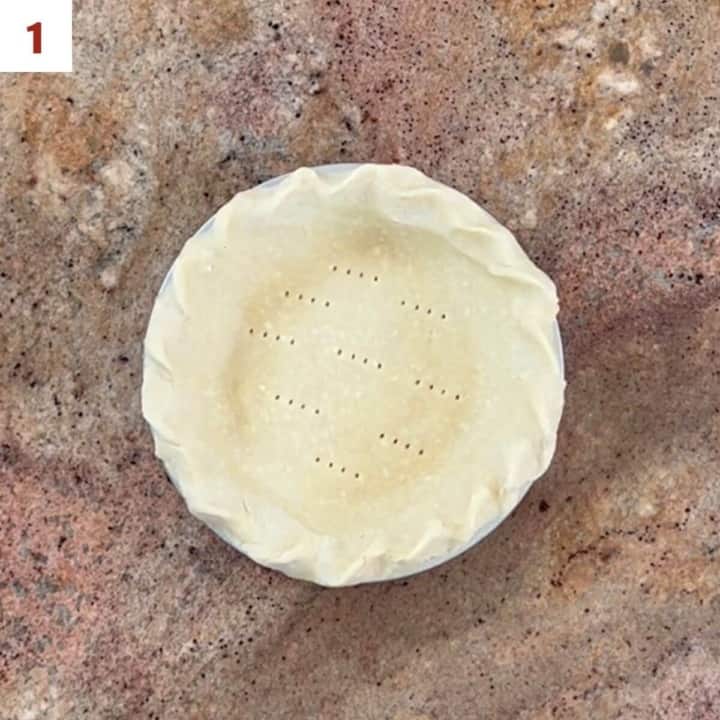
Roll the dough out to a 12-inch circle and ease it into a 7-inch pie pan, trimming the edges to about ½-inch.
Fold the overhang under and crimp decoratively. Save any scraps in the fridge, just in case you need to patch any holes later. Dock the bottom of the pie shell with a fork (photo 1).
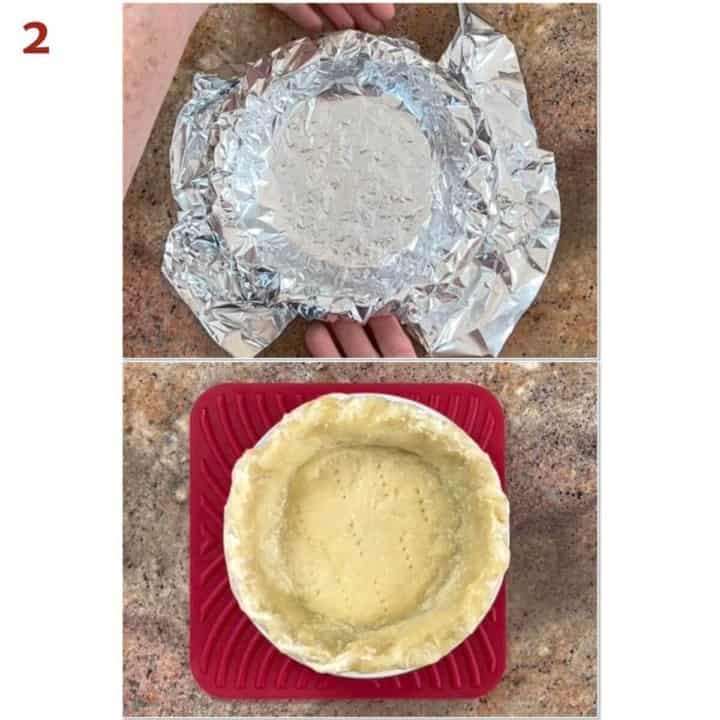
Step 2: Par-bake the pie shell
I use the frozen-foil method to par-bake the crust. Here's how to do it:
- Spray a piece of foil with baking spray (or butter it well)
- Press the foil tightly into the pie pan, covering the dough and wrapping it around the rim to fit the sides of the pie pan.
- Freeze the wrapped crust for 15 minutes, then bake the frozen pie shell at 400˚F for 20 minutes.
This method is easier than using beans, rice, or other pie weights, especially for a smaller 7-inch pie shell (photo 2). Feel free to use whatever method suits you.
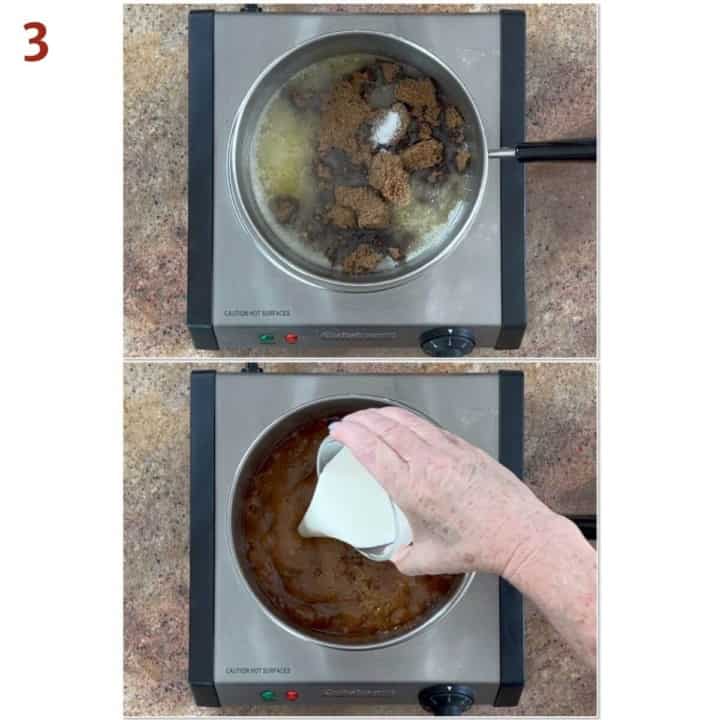
Step 3: Make the filling
In a medium heavy-bottomed saucepan, melt the butter over Medium heat. Add the brown sugar and salt. Cook, stirring constantly, until the mixture is fully combined and starting to bubble, about 2 to 3 minutes.
Stir in the heavy cream, lifting off the heat if necessary to keep the butterscotch from bubbling over. Remove the pan from the heat and let the mixture cool for 15 minutes (photo 3).
Cool the filling before proceeding
Be sure to let the cooked brown sugar mixture cool before whisking in the eggs so they don't scramble.
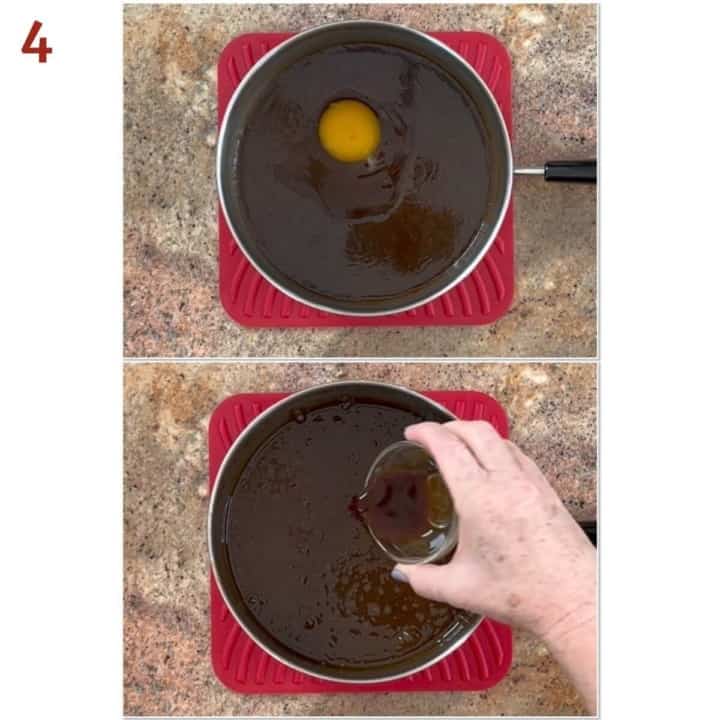
Whisk in the eggs into the cooled filling, one at a time, then add the vanilla extract (photo 4).
Set the filling aside while the shell is par-baking.
Step 4: Bake the pie
Remove the par-baked pie shell from the oven and take off the foil. If any parts of the shell have puffed up, just press them gently back into place. Patch any tears or cracks with reserved dough scraps.
Pour the pie filling into the hot pie shell and return the pan to the oven.
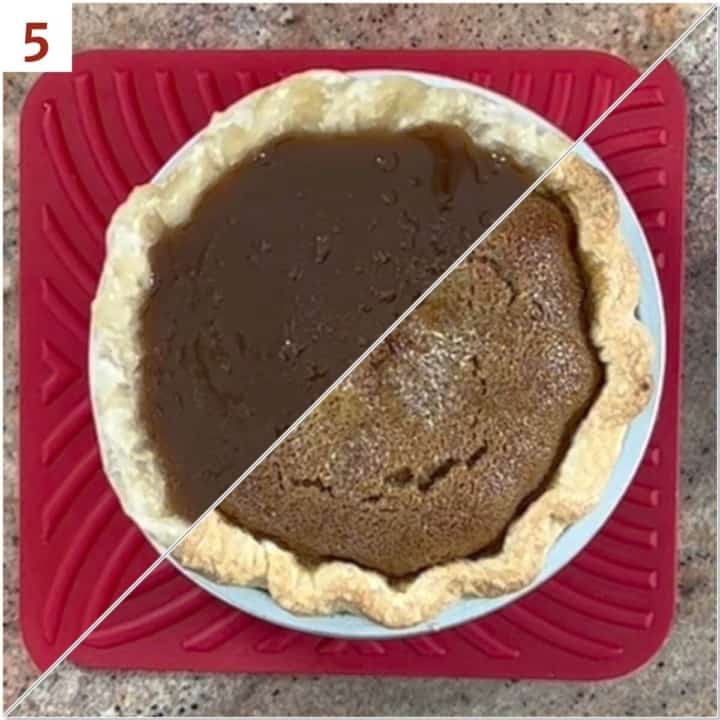
Let the pie cool completely before slicing. Serve chilled or at room temperature with lightly sweetened whipped cream - chilled slices will be firmer, while letting the pie sit briefly at room temperature gives the filling a softer, creamier texture.
Storage and make-ahead instructions
Storage instructions: Butterscotch pie can be stored in the refrigerator, covered tightly, for about a week.
Make-ahead instructions: The pie dough can be made ahead and stored, wrapped tightly in plastic wrap in the refrigerator for several days.
You can also bake the pie a day ahead and refrigerate it once completely cool.
Troubleshooting tips
Here are some issues you might encounter when making this Butterscotch Pie:
- Filling is runny: The pie may be underbaked. Bake until the edges are set and the center has only a slight jiggle, then cool completely before slicing.
- Filling looks curdled: The butterscotch mixture was probably too hot when the eggs were added. Let it cool for the full 15 minutes, then whisk in the eggs one at a time.
- Filling bubbled over: Cream can make the hot butter-sugar mixture foam quickly. Add it carefully and lift the pan off the heat if needed.
- Crust puffed during par-baking: Gently press it back into place while hot; patch any cracks with reserved dough scraps.
- Bottom crust is soggy: Make sure the crust gets its full par-bake before adding the filling.
- Pie cracks after baking: It was likely baked a little too long. Remove it while the center still jiggles slightly - it will continue to set as it cools.
Pie dough scaling
When making a homemade pie crust, you want to make enough pie dough to fill the pan, but not have too much left over. Being able to scale the recipe to minimize waste is nice, and that's why I like to use the recipe ratio for pie crusts.
In a nutshell, a pie crust has a 3 : 2 : 1 ratio of flour : fat : liquid (by weight - a kitchen scale is helpful here). So for a single 9-inch pie, you'd use a 9 : 6 : 3 ratio, or 9 ounces of flour, 6 ounces of your preferred fat, and 3 ounces of cold water.
If you want to see the conversion from these weight measurements to volume measurements, head to my pie crust recipe and scale it to your needs.
Mini vs. full-sized butterscotch pie
- 7-inch mini pie: Use the recipe as written with a 6 : 4 : 2 pie crust ratio. Bake as directed.
- 9-inch full-sized pie: Double the filling ingredients and use one standard single pie crust (9 : 6 : 3 ratio). Bake for 10 minutes at 400°F, then reduce the oven to 300°F and bake for another 25 to 30 minutes.
Math and Pi(e)
All this pie scaling brings me to one of my favorite food-meets-math occasions: Pi Day!
I love Pi Day (March 14th, or 3/14), a day fully created to make my math tutor/chef's heart skip a beat. Not to bring back nightmares from Geometry, but pi (π), an irrational number representing the ratio between the circumference and diameter of a circle, is 3.14159…). This is definitely a day for Math nerds.
I, of course, also love pie, and math plays a part in that, too. To adjust a recipe from a full-sized pie in a 9-inch pie pan to a mini pie in a 7-inch pie pan, just divide the recipe ingredient amounts in half.
When you want a pie with big flavor, that serves a small party without too much leftover, a mini pie does the job nicely. This mini Butterscotch Pie celebrates Pi Day well, with pie and math!
p.s. We lost Dr. Stephen Hawking, that eminent astrophysicist, on Pi Day, 2018. Hobbled in body, Dr. Hawking's mind soared in the universe using math as his spaceship. I think Pi Day is a fitting day to celebrate his life, don't you?
Questions asked and answered
Here are some questions that you might have...
Caramel sauce is made by cooking granulated sugar, then adding cream, butter, and flavoring. Butterscotch sauce is similar, but it's made with brown sugar instead, giving a deeper toffee flavor from the molasses. Also, with butterscotch, the brown sugar is cooked in melted butter rather than adding it at the end.
They're similar because brown sugar provides the signature caramel-molasses flavor in both, but they're not quite the same. My Butterscotch Pie starts by cooking brown sugar with butter and cream to create a butterscotch base before adding the eggs. My Southern Brown Sugar Pie uses a different filling and method, so the finished pies have their own textures and flavors.
Traditional butterscotch cream pies often use egg yolks in a stovetop pudding-style filling, leaving the whites available for a meringue topping. This version uses whole eggs in a baked filling instead, so I serve it with lightly sweetened whipped cream.
Didn't find the answer you're looking for?
Ask AI to answer for this specific recipe:
Disclaimer: I am not responsible for the quality of AI information



I hope you like this recipe! Let me know if you have any questions, and don't forget to leave a comment and rating. Thanks!
Slainté! L'chaim! Cheers!
- Tammy
More pie, tart, & cobbler recipes to try
Recipe

Butterscotch Pie
Equipment
Ingredients
For the crust
- ½ recipe double pie crust, homemade or store bought, see Recipe Notes
For the filling
- ¼ cup unsalted butter
- ¾ cup brown sugar, light or dark, see Recipe Notes
- ¼ teaspoon kosher salt
- ⅓ cup heavy cream
- 3 large eggs, at room temperature
- 2 teaspoons pure vanilla extract
- whipped cream, lightly sweetened, for garnish
Instructions
- Heat oven to 400 °F.
- Make the pie shell: Prepare a half recipe for a double pie crust (see Recipe Notes). Roll the dough out to a 12-inch circle, about ⅛- to ¼-inch thick. Ease the dough into the pie pan, and trim the edges to about ½-inch.
- Fold the overhang under and crimp decoratively. Save any scraps in the fridge, just in case you need to patch any holes later. Dock the bottom of the pie shell with a fork.
- To par-bake the crust, spray a piece of foil with baking spray (or butter it well), and press tightly into the pie pan, covering the dough and wrapping it around the rim to fit the sides of the pie pan. Freeze the wrapped crust for 15 minutes, then bake the frozen pie shell for 20 minutes.
- Make the filling: In a medium heavy-bottomed saucepan, melt ¼ cup unsalted butter over medium heat. Add ¾ cup brown sugar and ¼ teaspoon kosher salt. Cook, stirring constantly, until the mixture is fully combined and starting to bubble, about 2 to 3 minutes.
- Stir in ⅓ cup heavy cream, lifting off the heat if necessary to keep the butterscotch from bubbling over. Remove the pan from the heat and let the mixture cool for 15 minutes.
- Whisk in 3 large eggs into the cooled filling, one at a time, then add 2 teaspoons pure vanilla extract. Set the filling aside while the shell is par-baking.
- Remove the par-baked pie crust from the oven and take off the foil. If any parts of the shell have puffed up, just press them gently back into place. Patch any tears or cracks with reserved dough scraps.
- Pour the pie filling into the hot pie shell and return the pan to the oven.
- Bake the pie for 10 minutes at 400 °F, then reduce the heat to 300 °F and bake for another 20 to 25 minutes or until the pie jiggles slightly in the center when moved. Transfer the pie to a wire cooling rack and cool completely.
- Let the pie cool completely before slicing. Serve chilled or at room temperature with lightly sweetened whipped cream - chilled slices will be firmer, while letting the pie sit briefly at room temperature gives the filling a softer, creamier texture.
- Storage instructions: Butterscotch pie can be stored in the refrigerator, covered tightly, for about a week.
- Make-ahead instructions: The pie dough can be made ahead and stored, wrapped tightly in plastic wrap in the refrigerator for several days.Bake the pie a day ahead and refrigerate it once completely cool. Let it sit briefly at room temperature before serving if you prefer a softer, creamier texture, and add the whipped cream just before serving.
- A mini Butterscotch Pie is rich and flavorful, so for us it makes 6 slices. Your yield may vary.


Nicole says
My family and I LOVE pie. I want to be able to bake new pies more often, but without the guilt of eating leftover pie for days. I recently inherited 7-inch pie pans, so I'll be able to make my dreams come true. Thanks for doing the conversion work for me!
Tammy Spencer says
Happy (pie) baking, Nicole! 😉