

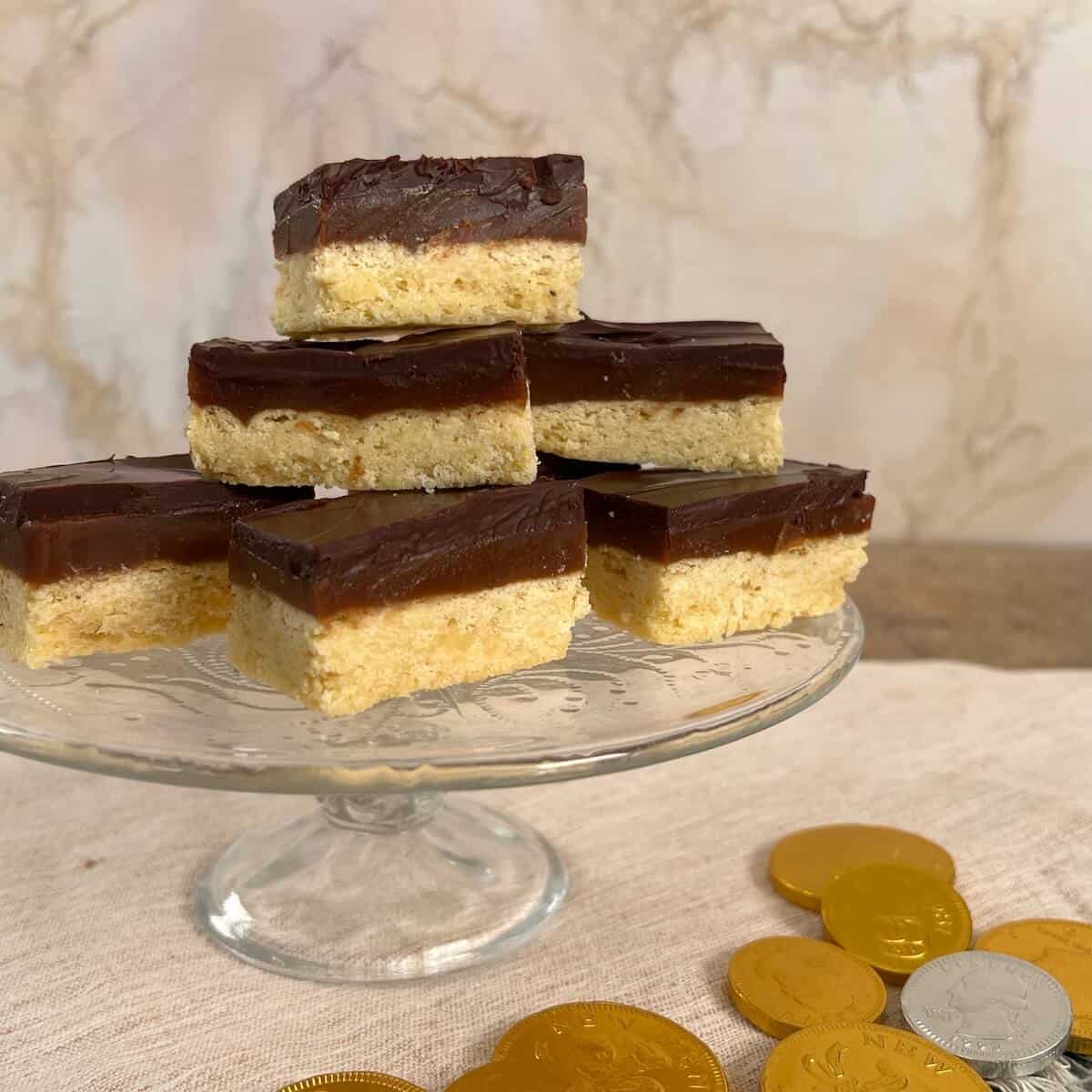
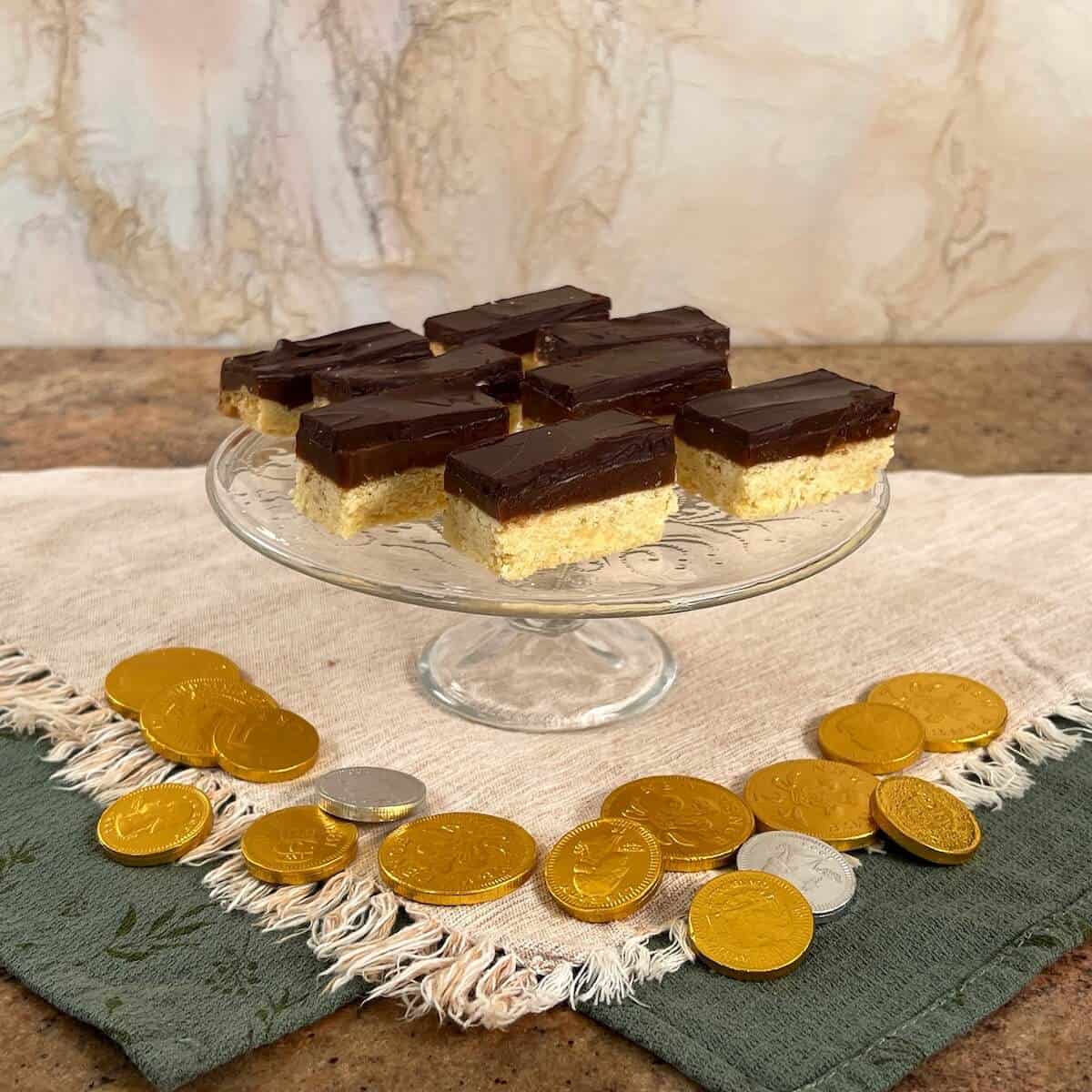
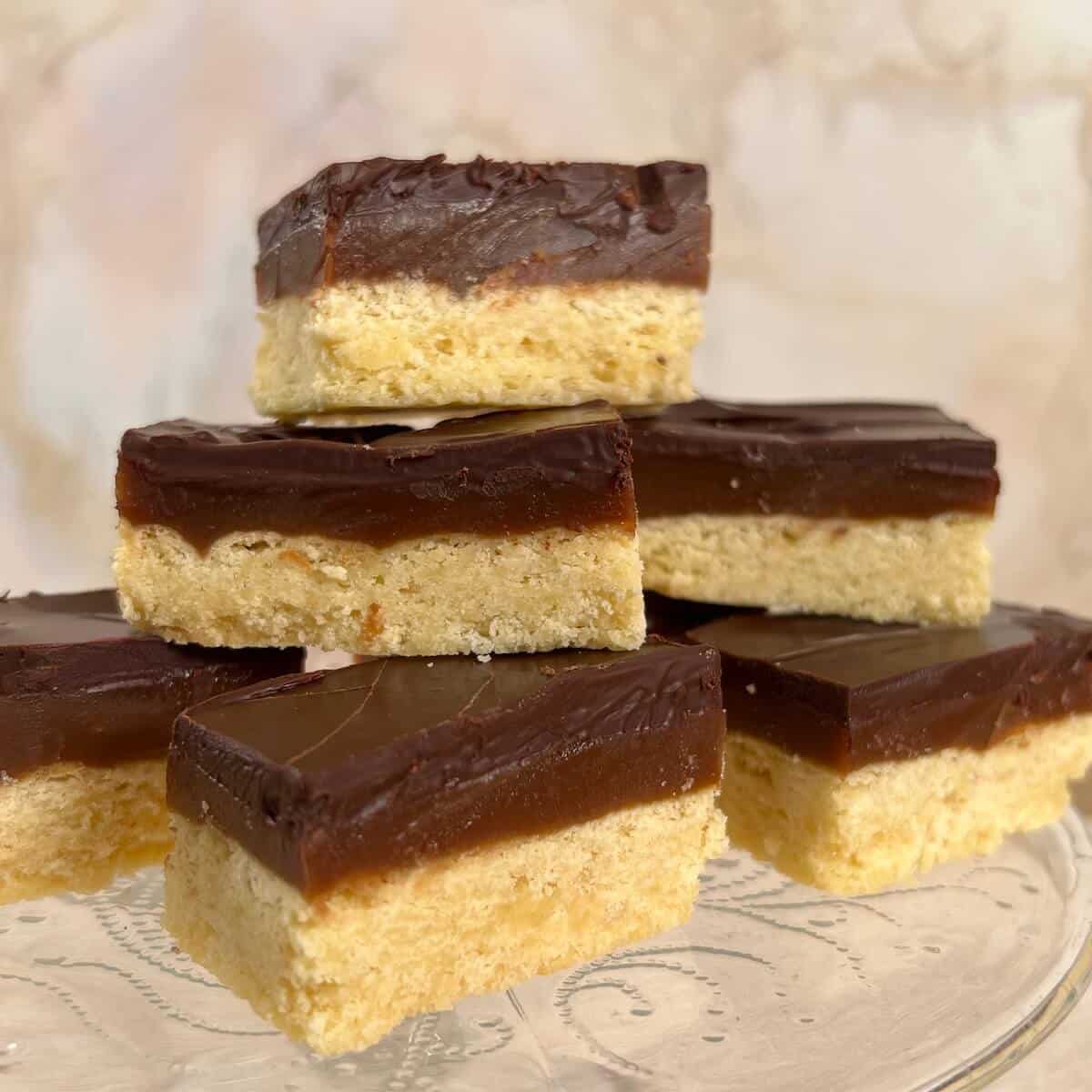
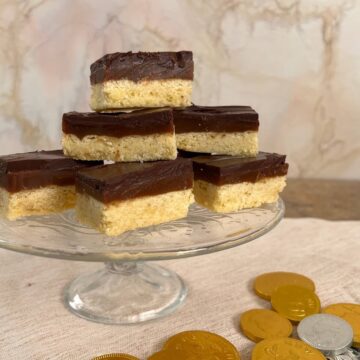
If you love buttery Scottish shortbread and swoon for caramel and chocolate, you'll love Millionaire's Shortbread. These layered chocolate caramel shortbread bars marry tender shortbread with a rich homemade caramel, and top it with a smooth chocolate ganache blanket. It's a three-step recipe that rewards a little patience with stunningly delicious results!
Jump to:
- Quick Recipe Summary ✨
- Why this recipe works
- Math and science in one delicious dessert
- Recipe ingredients
- Bar height vs. pan sizing
- How to make Millionaire's Shortbread
- Storage and make-ahead instructions
- Cutting even bars
- What can go wrong when making caramel
- Questions asked and answered
- More recipes featuring shortbread to try
- Recipe
- Comments
Quick Recipe Summary ✨
Classic Millionaire's Shortbread: Features a buttery Scottish shortbread base, a soft homemade caramel, and a smooth chocolate ganache topping.
From-scratch caramel: No sweetened condensed milk used, so you control the sweetness, flavor, and texture.
Active Time: about 45 minutes • Chill Time: 5 to 6 hours • Total Time: about 6 to 7 hours (mostly hands-off!)
Difficulty Level: ⭐⭐⭐ Medium. Easy shortbread and ganache, with precise caramel cooking (don't worry, there are step-by-step tips included!)
Yield: 32 (1×2-inch) bars • Freezer-friendly: Up to 3 months • Make-ahead: Layers can be made over 2 to 3 days.
👉 Follow the detailed instructions and troubleshooting tips below to make bakery-quality homemade Millionaire's Shortbread with perfect caramel texture and clean slices every time.
SUMMARIZE & SAVE THIS CONTENT ON
Why this recipe works
- Uses a classic Scottish shortbread base for authentic flavor
- From-scratch caramel lets you control sweetness and texture
- Dark chocolate ganache balances the rich caramel beautifully
- Make-ahead friendly-great for parties or holiday baking
- Step-by-step instructions, tips, and a troubleshooting guide all help to ensure success!
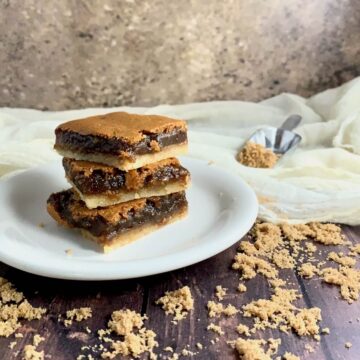
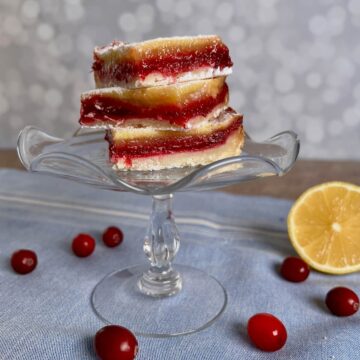
I love Scottish shortbread - it's wonderful on its own as cookies, or used as a base for layered bars, like Brown Sugar Pie Bars or Cranberry Lemon Bars.
If you really want to dress up shortbread, coat it with a layer of caramel and a blanket of chocolate ganache. Voila, you have Millionaire's Shortbread!
Making these layered chocolate caramel shortbread bars is a three-step process. The shortbread and ganache are quick and easy, while the caramel requires precision and patience.
You'll be rewarded with a delicious over-the-top dessert that thrills your tastebuds with its combination of sweet, buttery, crunchy, chocolatey goodness!
Math and science in one delicious dessert
[Side note: You don't have to be a science nerd like me. If you want to get to the baking, just skip this section.]
Millionaire's Shortbread (aka Caramel Shortbread) is a British dessert made of a shortbread base, caramel filling, and chocolate topping. It's also a lesson in math and science from its component parts. Given my background in Engineering, you'll forgive me as I geek out about it all!
Shortbread math: the 3 : 2 : 1 ratio
Math appears in the form of recipe ratios from the shortbread. I've written a separate post about why is shortbread called shortbread and a bit of its history. In that post I mention the 3 : 2 : 1 recipe ratio of 3 parts flour, 2 parts butter, and 1 part sugar (by weight - my kitchen scale gets lots of use).
There are many different versions of the flour : fat : sugar ratios in shortbread recipes, and how soft, sweet, or buttery the results are varies considerably. Interesting, considering that you'd think only having three ingredients wouldn't leave much wiggle room.
Caramel science: the soft-ball stage
Then there is the sugar science of candy making for the caramel filling. If baking is temperamental (pitfalls from inaccurately measured ingredients to overheated or underheated ovens), working with sugar is downright ornery. When you're boiling sugar for candy, like for Tahini Halva, a few degrees can make a huge difference. Patience is definitely needed for success.
There are six stages in candy making: thread, soft-ball, firm-ball, hard-ball, soft-crack, and hard-crack. (Boy, there are so many asides I could make about these names!)
I have a whole discussion about soft-ball stage candy in my Southern Pecan Pralines recipe if you want to learn more. Here's also a deeper look into caramel temperatures if you're so inclined.
The caramel used for this Millionaire's Shortbread recipe is cooked to soft-ball stage, when the sugar syrup will have some cohesion, but it will keep the candy soft (think fudge). In comparison, Caramel Sauce is cooked to the thread stage of candy making, keeping it more fluid and pourable.
Ganache texture: why butter, not cream?
Traditionally, chocolate ganache is equal parts chocolate and heavy cream, by weight. Here we're using butter in the ganache instead of heavy cream because we just want to soften the chocolate topping enough to not be brittle when cut or bitten.
Recipe ingredients
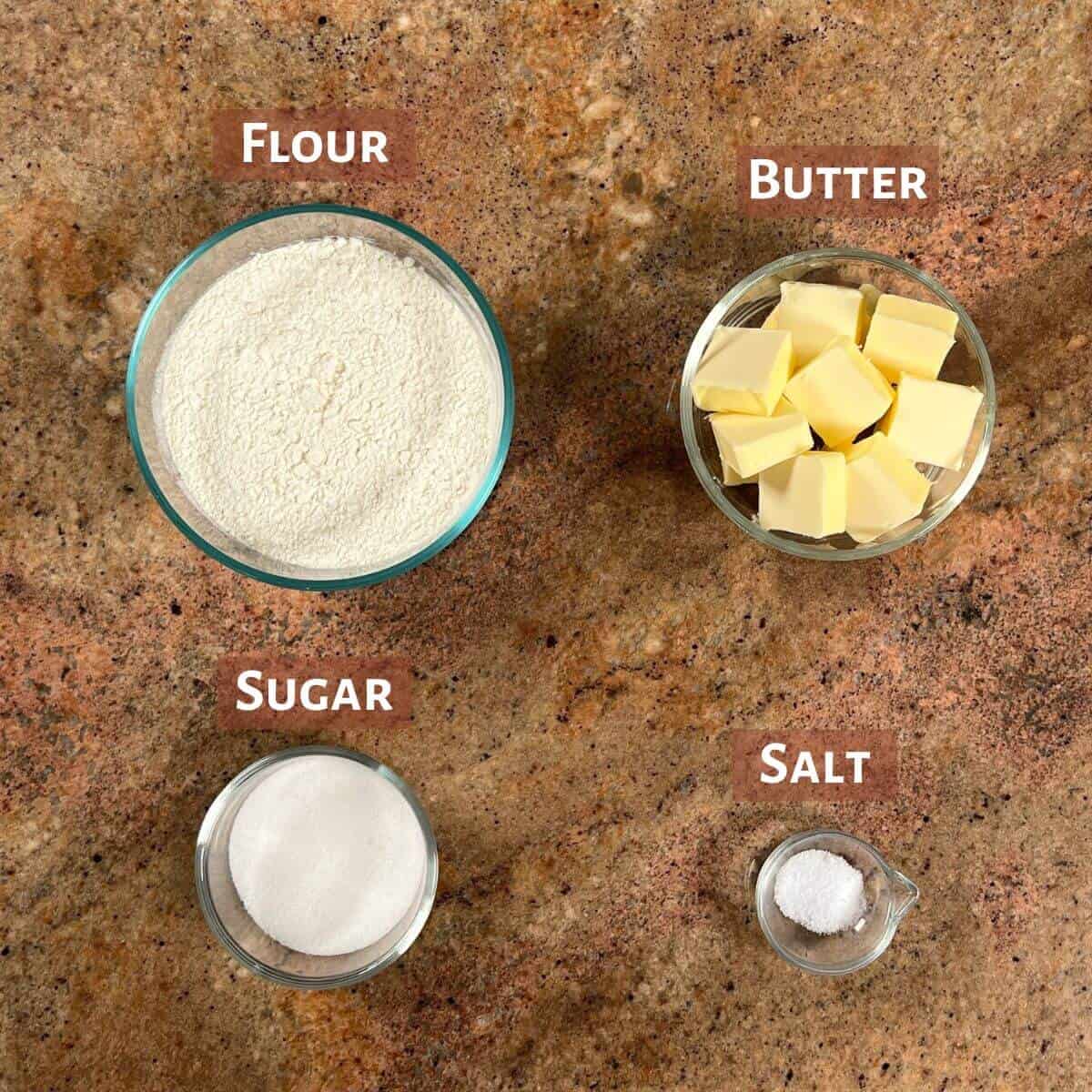
You'll need the following ingredients to make the shortbread base for this Millionaire's Shortbread recipe:
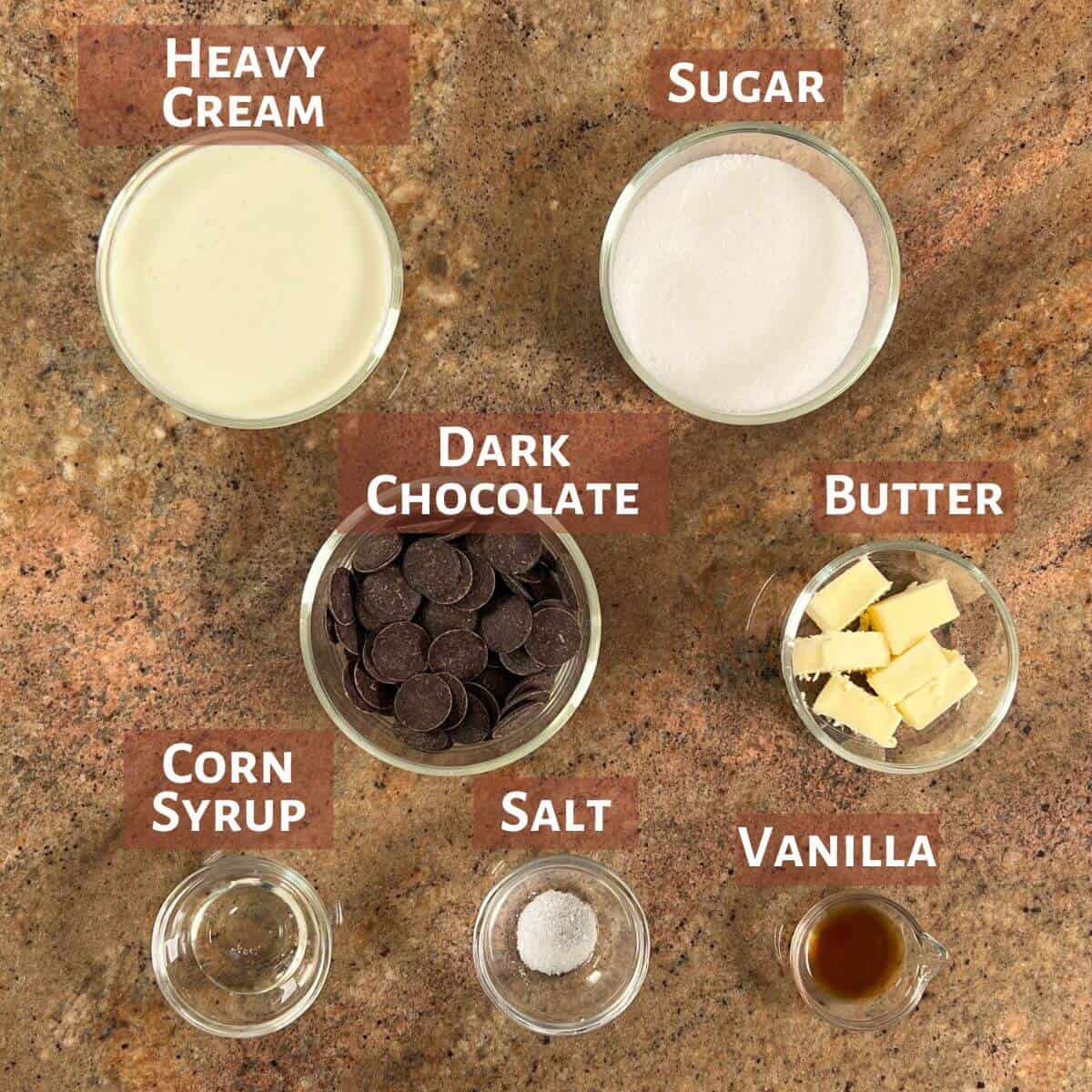
And for the caramel and chocolate ganache layers, you'll need these ingredients:
Ingredient Notes
Millionaire's Shortbread is made of 3 layers: the shortbread base, a vanilla salted caramel, and a chocolate ganache topping, all made with basic pantry staples.
Let's talk about some of the ingredients for each element separately.
For the shortbread base
You'll need flour, sugar, butter, and salt to make this shortbread base.
Flour: I highly recommend using a kitchen scale to measure out the ingredients, especially the flour. You don't want to over-measure it and end up with an overly dry dough which will lead to a crumblier base.
This shortbread recipe has a little less flour than the recipe ratio for traditional shortbread would suggest. This is so the base won't be too short (that is, more crumbly), yet still have enough structure to support the other layers.
For gluten-free shortbread, use the same amount of 1 : 1 gluten-free all purpose flour.
For the caramel filling
The caramel uses sugar, heavy cream, and butter, plus a few optional (but recommended) ingredients.
Many other recipes use sweetened condensed milk to make caramel, but that doesn't give you the choice of how sweet the caramel will be, or the luxury of flavoring it to your liking. I like having control, even if it means a few extra steps.
Sugar: The essence of caramel is sugar that has been melted and browned. It's very easy to burn the sugar as it melts, so it's important to keep a watchful eye on it.
Heavy cream: Loosens the caramel and adds its creamy rich flavor to the sauce. Warming the heavy cream helps the caramel to stop cooking and prevents the caramelized sugar from overcooking and burning.
Water (not shown) and corn syrup: Used to stabilize the sugar as it melts and caramelizes. Both aren't strictly necessary, but recommended. You can also use honey, agave syrup, or golden syrup instead of the corn syrup (since we're using such a small amount, they won't noticeably change the flavor of the finished product). See the FAQs for more information.
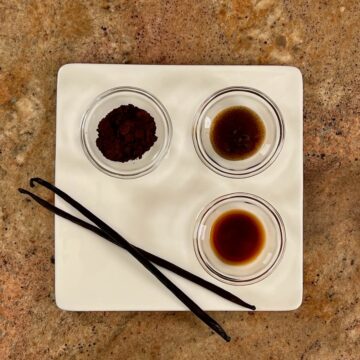
Flavorings: Here I'm using both salt and vanilla extract to make, you guessed it, a Salted Vanilla Caramel. They're both optional (for example, you can leave out the vanilla to make Salted Caramel Millionaire's Shortbread if you'd prefer), but I think both are totally worth it.
For the ganache topping
This simple ganache is just dark chocolate mixed with butter. Making the topping this way, rather than using just melted chocolate, keeps the topping from being too hard to cut and bite into.
Dark chocolate: I like to make ganache with dark chocolate because it contrasts nicely with whatever sweet item I'm putting it on. The best types of chocolate to use are chocolate wafers or a bar of good chocolate. Candy melts (aka candy wafers, confectionery coating, compound coating, or compound chocolate) use lower quality ingredients than in pure chocolate, producing a lesser flavor profile, in my opinion. And save the chocolate chips for another day - they don't melt as smoothly.
See the recipe card for a full list of ingredients and measurements.
Bar height vs. pan sizing
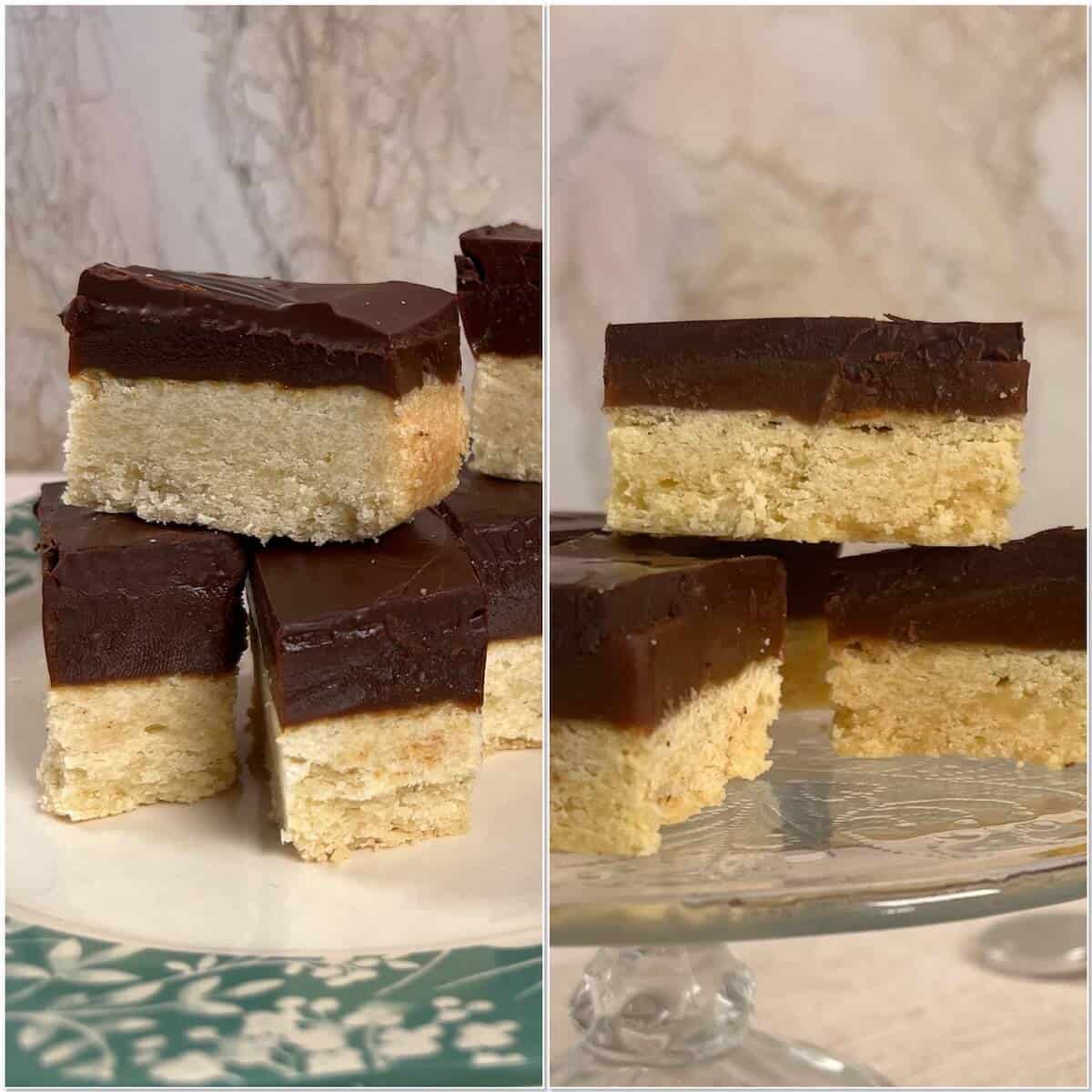
The total height of the bars and thickness of the shortbread and caramel for the finished chocolate caramel bar is determined by the size of your baking pan:
- An 8- x 8-inch baking pan will yield a bar that is about ¾-inches (19mm) high, with a taller shortbread base of about ⅝-inch (16mm) thick and a thicker caramel layer (left photo).
- A 9- x 9-inch baking pan will yield a bar that is about ½-inch (12mm) high, with a shorter shortbread base of about ¼ -inch (6mm) thick and a thinner caramel layer (right photo).
This recipe is written using the larger-sized pan. If you'd prefer the taller, thicker bars, use the smaller pan instead and reduce the amount of chocolate wafers by about an ounce so that the ganache won't be too thick.
How to make Millionaire's Shortbread
Step 1: Make the shortbread base
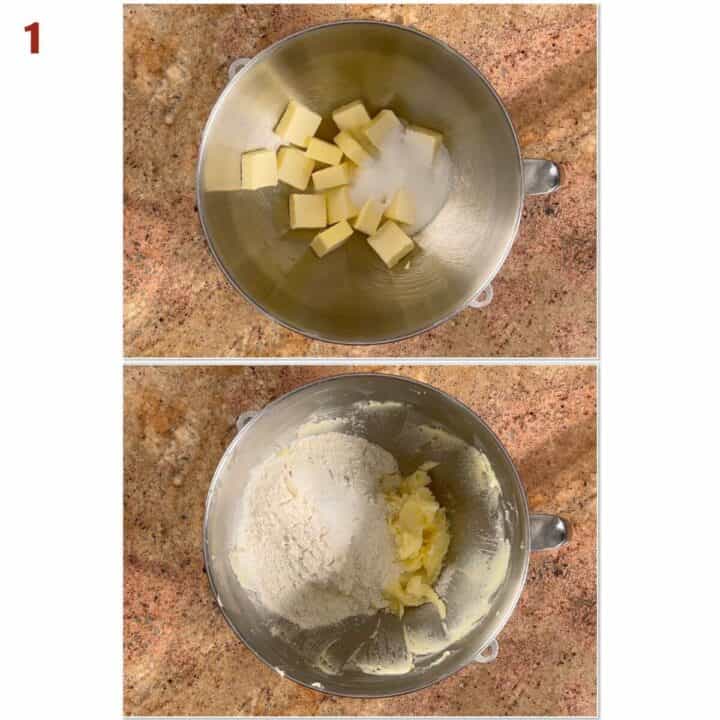
Beat together the butter and sugar
until light and creamy. Add the flour and salt and mix on low speed just until a smooth dough forms (photo 1).
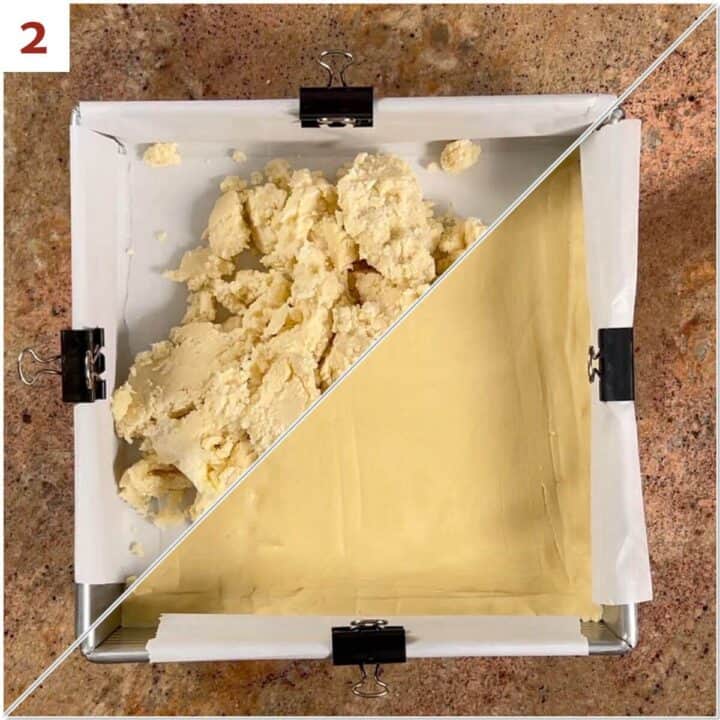
Line a 9- x 9-inch baking pan with two pieces of parchment paper, laying them at perpendicular angles and leaving an overhang on all four sides.
Pat the dough into the prepared baking pan (photo 2).
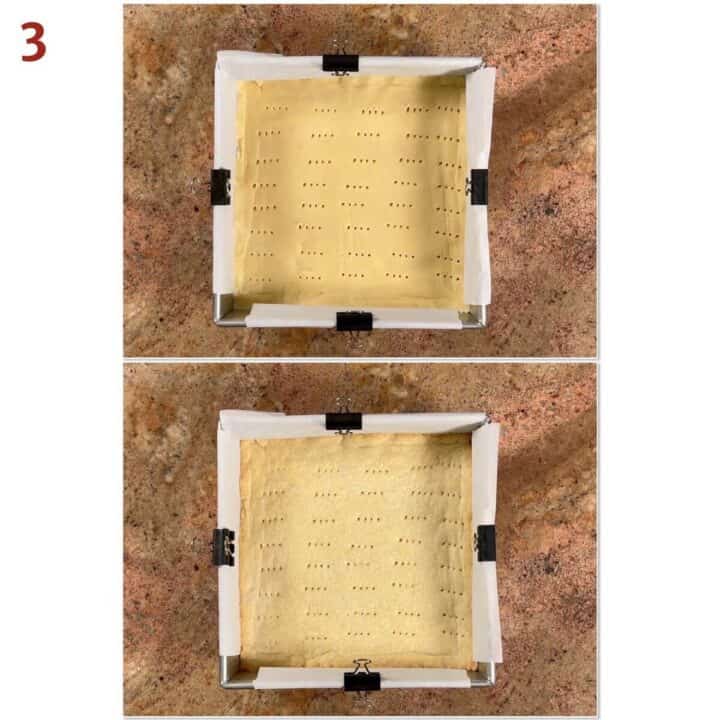
Pierce the dough with a fork, then bake for 20 to 25 minutes or until lightly browned. Remove from the oven to a wire rack and cool while you make the caramel (photo 3).
Step 2: Make the caramel filling
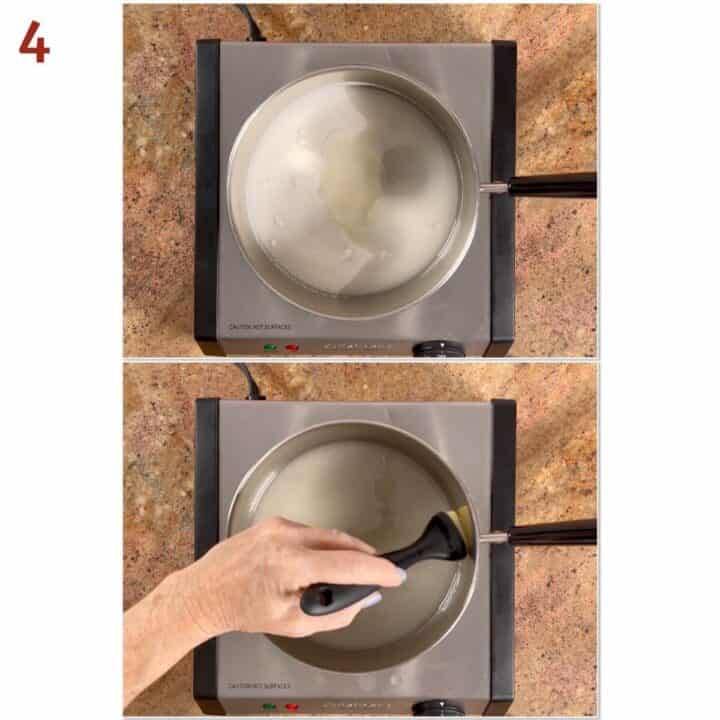
Stir together the sugar, water, and light corn syrup (if using) until the mixture looks like wet sand.
Bring the sugar mixture to boil over medium heat, washing down the sides of the saucepan with a wet pastry brush dipped in cold water (photo 4).
How to avoid the sugar crystalizing
DO NOT STIR the sugar mixture while you're caramelizing the sugar! You don't want to introduce any impurities that can cause the mixture to crystalize (that is, seize up and harden). Instead, washing down the sides of the pan with a wet pastry brush helps to minimize that risk.
If the sugar does end up crystalizing during the melting stage, add some water with 1 to 2 tablespoons of corn syrup to soften the sugar crystals, then cook the mixture again until it reaches the correct color.
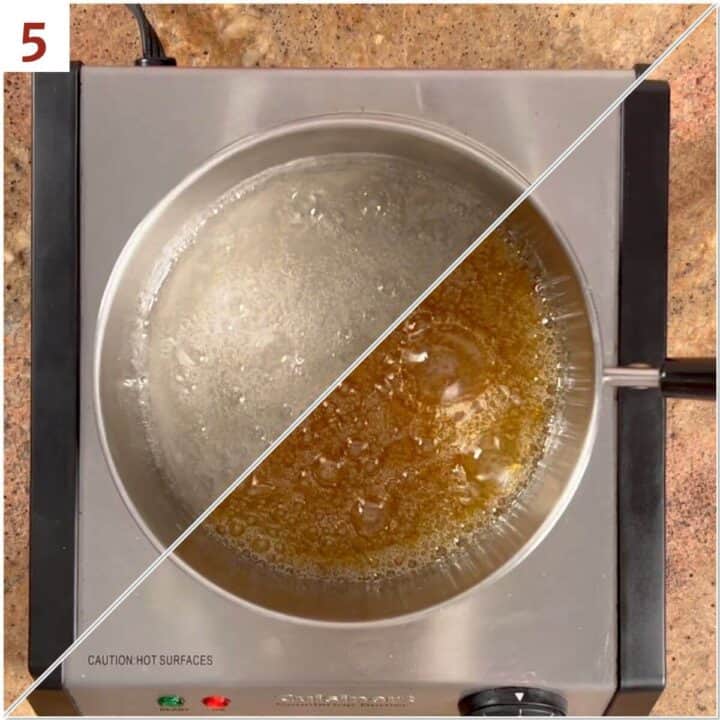
Cook the sugar until the caramel has a deep amber color, about 8 to 10 minutes (photo 5).
Look and listen for clues when the caramel is done
You need to be focused when caramelizing sugar - it can go from light amber to a black mess very quickly at the end, so keep an eye on it and remove from heat as soon as the desired color is reached.
In addition, listen to the sugar as it boils. As sugar caramelizes, it goes from noisy bubbling to quieter, thicker boiling. That sound shift is your cue that it's almost ready.
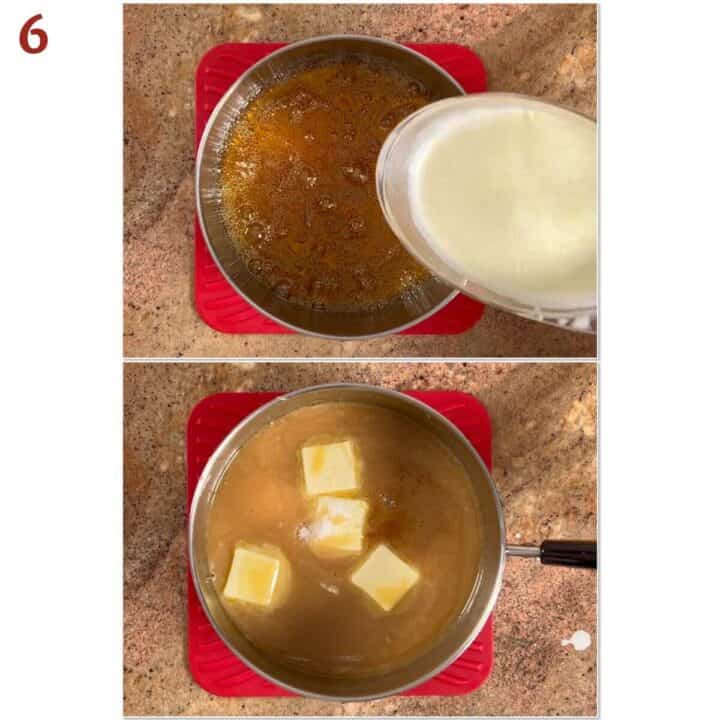
Once a deep amber color is reached, remove from heat and SLOWLY add the heavy cream. The mixture will boil up, so stir continuously to keep the mixture from bubbling over.
Be sure to keep your face and hands away as best as you can to avoid steam burns.
Stir until the heavy cream is mostly incorporated, then add the butter and the vanilla extract and salt, if using (photo 6).
Return the pan to the heat, attaching a digital or candy thermometer to the side of the pan (but not touching the bottom).
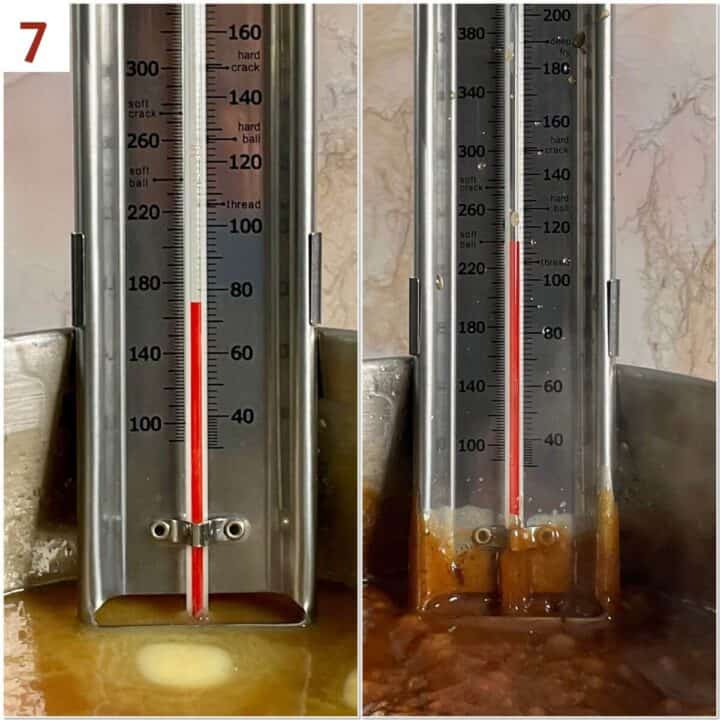
Bring the caramel back to a boil and cook, stirring frequently to keep the mixture from bubbling over until it registers 238 °F (114˚C), the soft-ball stage, about 20 minutes (photo 7).
Keep an eye on the caramel as it cooks
Don't get distracted - the caramel can burn at the bottom of the pan and ruin it if it's not stirred, especially towards the end of the cooking process.
When the caramel has come to temperature, remove the pan from the heat and stir it occasionally while it cools to 200 °F (93˚C), about 5 minutes.
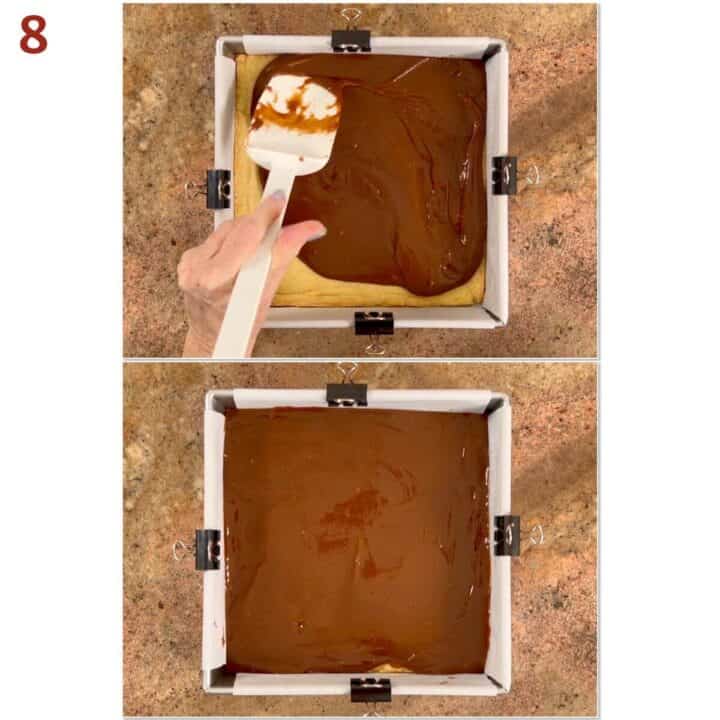
Pour the caramel on top of the shortbread base, spreading it evenly to the sides and into the corners.
Place the pan in the refrigerator, uncovered, and chill for at least an hour or until the caramel is firm (photo 8).
Cleaning tip
If the caramel has hardened in the saucepan so that it's hard to scrub clean, just fill it with water and bring to a boil. The boiling water will melt the leftover caramel so that it will release easily from the pan.
Step 3: Make the ganache topping
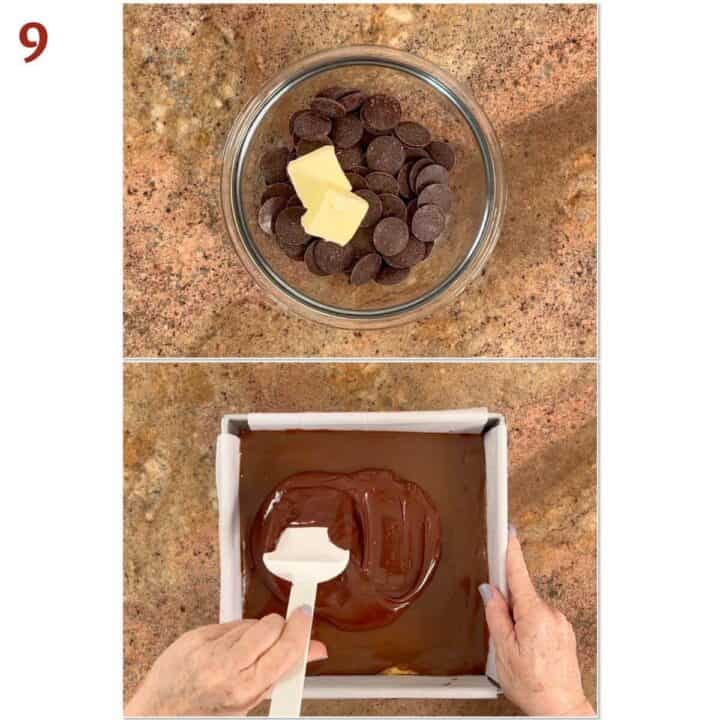
Melt the chocolate wafers and butter together in the microwave, stirring after 30 second intervals until melted and smooth, about 1½ minutes. You can also use a double boiler to melt the two together over the stove.
Pour the ganache evenly over the caramel layer, smoothing it out using a small offset spatula. Place the pan in the refrigerator again and chill for at least 4 hours to let it all firm up (photo 9).
Step 4: Portion into bars
Make sure the pan is straight out of the fridge and the chocolate is really firm before attempting to cut.
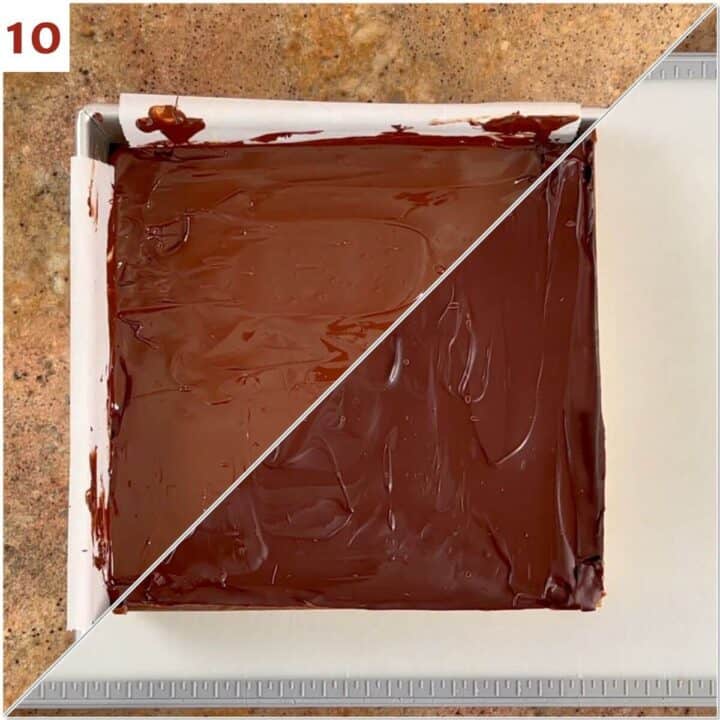
Take the slab of shortbread out of the baking pan by holding the sides of the top piece of parchment paper. If necessary, use a table knife to loosen any parts still stuck to the pan. Place it on a cutting board (photo 10).
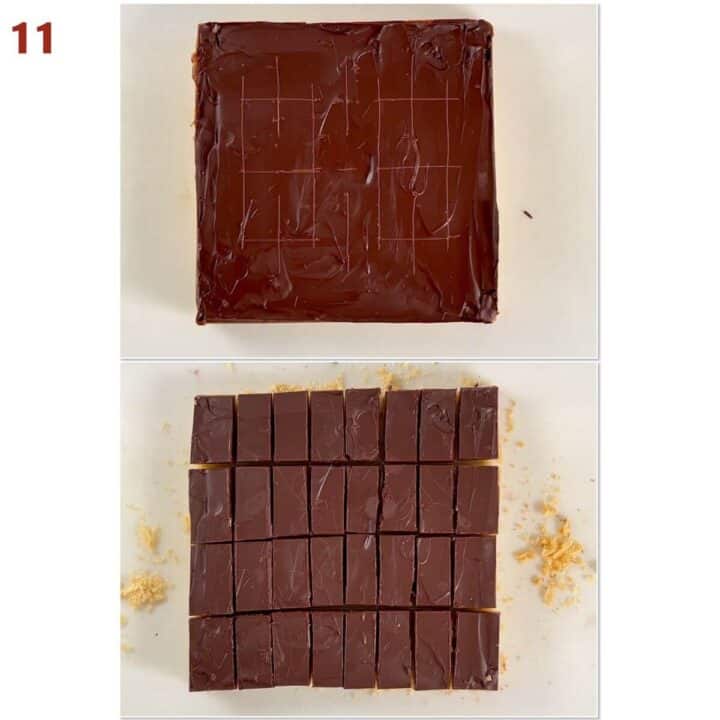
Using a chefs knife, cut the block into 1- x 2-inch pieces (photo 11).
Refrigerate the bars until ready to serve. They're best served chilled, or at least cool. If the bars sit out too long, the caramel will be soft.
How to cut clean bars
The best way to ensure your slices are clean is to dunk the knife in a jug of very hot water and dry it off with a paper towel between each cut (I have an old half-gallon milk jug set aside for this purpose). Also, try to cut the slab in one continuous slice rather than using a sawing motion.
Storage and make-ahead instructions
Storage instructions: Millionaire's Shortbread can be stored in an airtight container in the refrigerator for up to 7 days.
The bars can also be frozen for up to three months in a freezer-safe ziplock bag. Thaw them completely before serving, either in the refrigerator for a few hours (the best way) or at room temperature for about 30 minutes (making sure the bars don't become too soft).
Make-ahead instructions: You can make the layers over time (helpful if you're baking during the holidays!). Bake the shortbread base - it can be kept in its baking pan at room temperature for up to 3 days, or in the refrigerator for up to a week. The caramel and ganache can also be layered on in stages, chilling as needed.
Sample production timeline
- Day 1: Bake the shortbread base
- Day 2: Pour on the caramel filling, then chill
- Day 3: Finish with the ganache, chill thoroughly, then cut into bars
Yield Notes
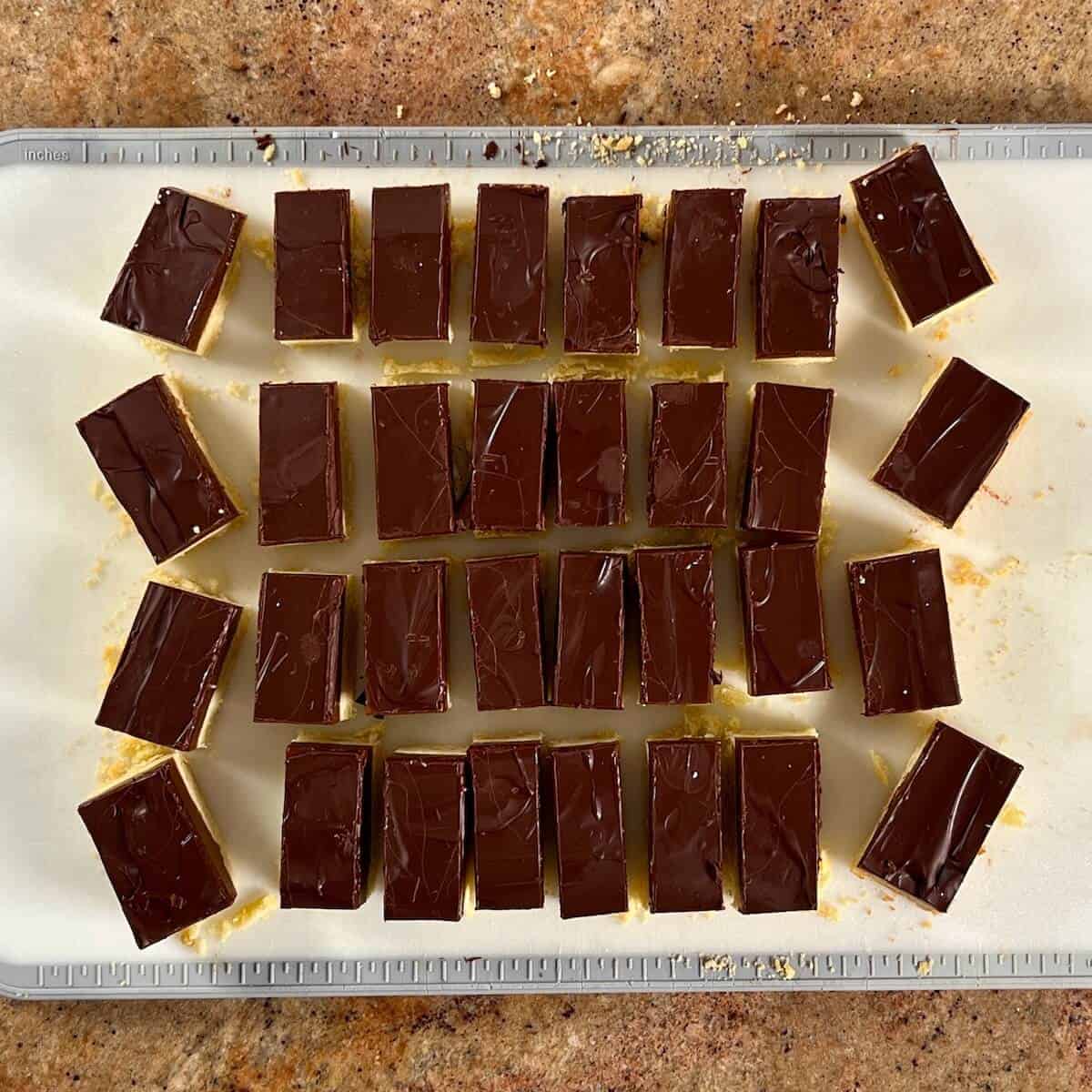
32 1- x 2-inch bars
Cutting even bars
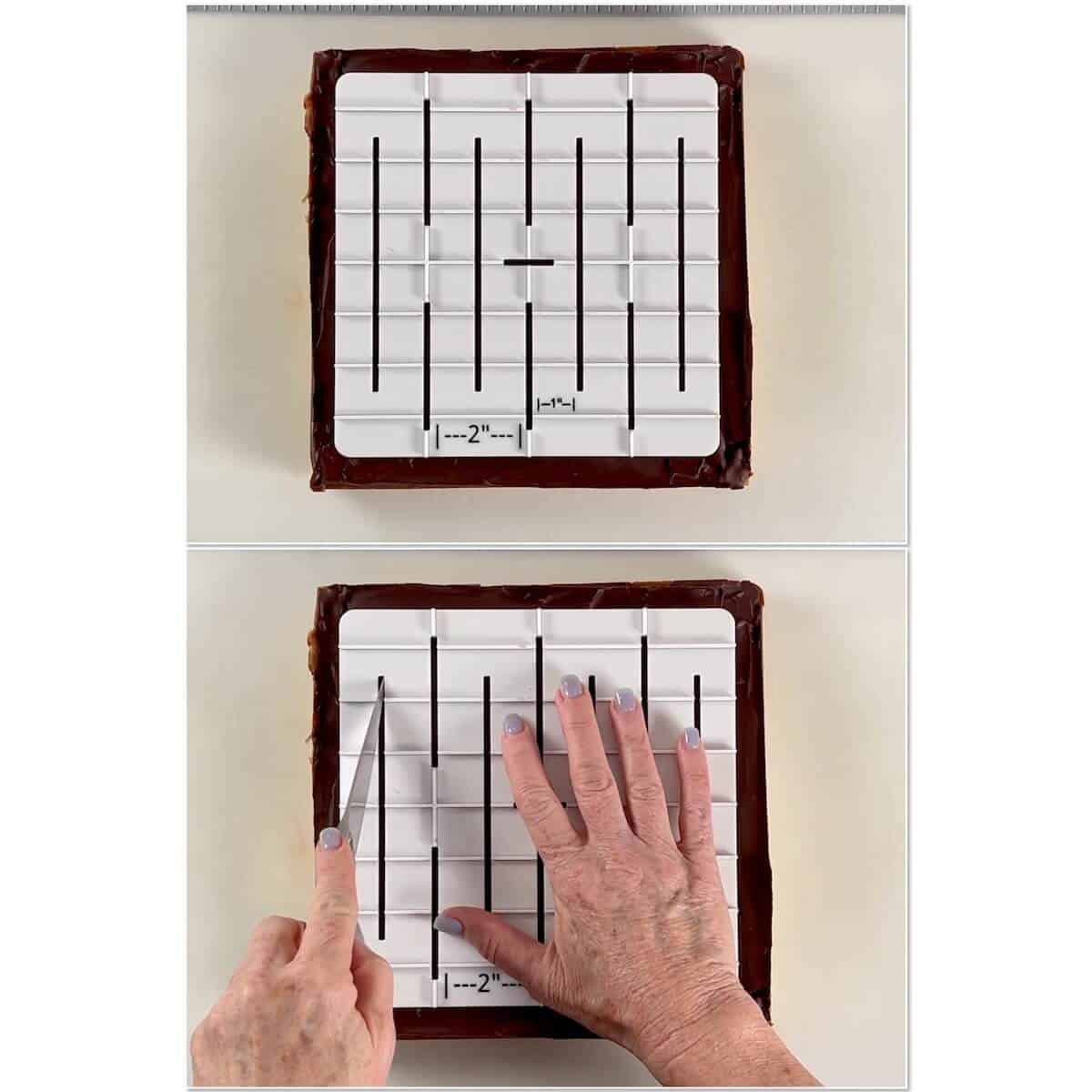
If you're like me, cookie bars don't end up been uniform in size as they're being cut. I try very hard to cut the bars straight, and I even measure the distances before starting. But somehow my knife goes awry.
I mentioned this problem to my daughters, and they designed and printed an ingenious cutting template that I used to cut the Millionaire's Shortbread evenly. I just scored the chocolate, and used the lines as a cutting guide. This version is for an 8- x 8-inch baking pan, and I can use it for most any 1- x 2-inch bars (like traditional shortbread) or 2- x 2-inch squares (like pecan bars).
Neat, huh!
If you're interested in this template, you can email me for more information.
What can go wrong when making caramel
There are four possible pitfalls when making caramel:
The sugar seizes up while it's melting
If the sugar crystalizes during the melting stage, some impurity got into the mixture. That's why it's important not to stir the mixture, instead wash down the sides of the pot with a pastry brush dipped in water.
Fix the sugar by adding some water with 1 to 2 tablespoons corn syrup to soften the sugar crystals, then cook the mixture again until it's reached the correct color.
The sugar gets too dark while caramelizing
Believe me, I've been there, getting distracted by life while caramelizing sugar. When that happens, there's no fixing it. You'll have to start over.
The caramel cooks for too long or not enough time
Cooking the caramel requires a bit of patience. The magic temperature is 238°F (the soft ball stage). This is the point in making caramel where the final product is like chewy caramel candy.
Having a digital or candy thermometer really helps, or you can use the drop-of-caramel-in-a-glass-of-water method and check the texture. Personally, I prefer the precision of thermometers, but you do you.
If you've undercooked the caramel topping, return it to the heat and cook until it's the right temperature. If you've over-cooked the caramel, there's not a whole lot you can do to fix the problem - the caramel will be too brittle to use as a Millionaire's Shortbread layer. Enjoy the candy you've made, and try again.
The caramel separates during cooking
You might notice as you're cooking the caramel, it doesn't have that smooth consistency you're expecting - instead, it looks grainy or separated. According to HomeDiningKitchen, this is "typically due to the sugar crystallizing or the fat content in cream or butter causing separation." You can read more about the science behind this at their website.
You can fix the caramel by adding 1 to 2 tablespoons of water, then cooking the caramel over low heat, whisking continuously, until a smooth texture appears. Gradually increase the heat while still whisking, but don't let the caramel boil.
Questions asked and answered
Here are some questions you might have...
You poke holes in shortbread for the same reason as docking a pie crust. There's a lot of butter in the dough, and as it bakes it releases steam. Since you want the cookies to be nice and flat, poking holes allows the steam to escape so the shortbread bakes up flat and even.
Adding water to the sugar while it's caramelizing (called a "wet caramel") helps to keep the sugar from burning. If you leave it out, the sugar will turn amber faster, but you have to be super diligent, swirling the sugar in the pan to melt it evenly.
When granulated sugar is being melted to brown, the risk is that impurities can be introduced that will make the sugar crystallize (when the sugar molecules clump together). That's why we don't stir the sugar as it's melting.
Corn syrup is an invert sugar, made by breaking down table sugar (sucrose) into its simpler components. This creates a product with a structure opposite that of the original sugar. It retains moisture better and crystallizes less easily, thus stabilizing the granulated sugar as it caramelizes.
The bars can be frozen for up to three months in a freezer-safe ziplock bag. Thaw them completely before serving, either in the refrigerator for a few hours (the best way) or at room temperature for about 30 minutes (making sure the bars don't become too soft).
Many other recipes use sweetened condensed milk to make caramel, but that doesn't give you the choice of how sweet the caramel will be, or the luxury of flavoring it to your liking. I like having control, even if it means a few extra steps.
Didn't find the answer you're looking for?
Ask AI to answer for this specific recipe:

I hope you like this recipe! Let me know if you have any questions, and don't forget to leave a comment and rating. Thanks!
Slainté! L'chaim! Cheers!
- Tammy
More recipes featuring shortbread to try
Recipe
Millionaire's Shortbread (Chocolate Caramel Bars)
Equipment
- 9- x 9-inch baking pan see Recipe Notes
- 2-quart heavy saucepan
Ingredients
For the shortbread base
- 1 cup unsalted butter, softened
- ½ cup granulated sugar
- 2⅓ cups all-purpose flour, see Recipe Notes
- ½ teaspoon kosher salt
For the caramel filling
- 1¼ cups granulated sugar
- ¼ cup water, optional, see Recipe Notes
- 1 tablespoon light corn syrup, optional, see Recipe Notes
- 1⅔ cups heavy cream, warmed to 110 °F
- 4 tablespoons unsalted butter
- 1 teaspoon pure vanilla extract, optional, see Recipe Notes
- ¼ teaspoon kosher salt, optional, see Recipe Notes
For the ganache topping
- 7 ounces dark chocolate wafers, 60 to 72% cacao, or solid chocolate bar, coarsely chopped (1 cup + 2 tablespoons), see Recipe Notes
- 2 tablespoons unsalted butter
Instructions
- For the shortbread base: Preheat the oven to 350 °F. Line a 9- x 9-inch baking pan with two pieces of parchment paper, laying them at perpendicular angles and leaving an overhang on all four sides. It also helps to secure the paper to the sides of the pan with binder clips. Set aside.
- In the bowl of a stand mixer (or just a large bowl if using a hand mixer), beat together 1 cup unsalted butter and ½ cup granulated sugar until light and creamy. Add 2⅓ cups all-purpose flour and ½ teaspoon kosher salt and mix on low speed just until a smooth dough forms.
- Pat the dough into the prepared baking pan. Using plastic wrap and a pie pan roller helps get it even without making too much of a mess. Pierce the dough with a fork.
- Bake the shortbread for 20 to 25 minutes or until lightly browned. Remove from the oven to a wire rack and cool while you make the caramel.
- For the caramel filling: In a 2-quart heavy saucepan, stir together 1¼ cups granulated sugar, ¼ cup water, and 1 tablespoon light corn syrup (if using) until the mixture looks like wet sand. Bring the mixture to boil over medium heat. DO NOT STIR the sugar mixture during this process, but wash down the sides of the saucepan with a wet pastry brush dipped in cold water to minimize the risk of the mixture crystallizing.Cook the sugar until the caramel has a deep amber color, about 8 to 10 minutes. Watch it carefully as the caramel will turn dark very quickly at the end.
- While sugar is boiling, heat the heavy cream until warm, about 110 °F on a digital thermometer.
- Once a deep amber color is reached, remove from heat and SLOWLY add the 1⅔ cups heavy cream. The mixture will boil up, so stir continuously to keep the mixture from bubbling over. Be sure to keep your face and hands away as best as you can to avoid steam burns. Stir until the heavy cream is mostly incorporated, then add 4 tablespoons unsalted butter, and 1 teaspoon pure vanilla extractand ¼ teaspoon kosher salt (if using).
- Return the pan to the heat, attaching a digital or candy thermometer to the side of the pan (but not touching the bottom). Bring the caramel back to a boil and cook, stirring frequently to keep the mixture from bubbling over until it registers 238 °F (soft-ball stage), about 20 minutes. Don't get distracted - the caramel can burn at the bottom of the pan and ruin it if it's not stirred, especially towards the end of the cooking process.
- When the caramel has come to temperature, remove the pan from the heat and stir it occasionally while it cools to 200 °F, about 5 minutes.Pour the caramel on top of the shortbread base, spreading it evenly to the sides and into the corners. Place the pan in the refrigerator, uncovered, and chill for at least an hour or until the caramel is firm.
- For the ganache topping: In a small bowl, combine the 7 ounces dark chocolate wafers and 2 tablespoons unsalted butter. Melt the mixture in the microwave, stirring after 30 second intervals until melted and smooth, about 1½ minutes.Alternatively, heat a small saucepan containing 1-inch of water on stove until boiling. Place the chocolate and butter in a heat proof bowl then sit it over the saucepan. Stir occasionally until the mixture is completely melted and smooth.
- Pour the ganache evenly over the caramel layer, smoothing it out using a small offset spatula. Place the pan in the refrigerator again and chill for at least 4 hours to let it all firm up.
- Portion into bars: Make sure the pan is straight out of the fridge and the chocolate is really firm before attempting to cut. Take the slab of shortbread out of the baking pan by holding the sides of the top piece of parchment paper. If necessary, use a table knife to loosen any parts still stuck to the pan. Place it on a cutting board.
- Using a chef's knife, cut the block into 1- x 2-inch pieces. To ensure slices are clean, put the knife in a jug of hot water and dry off with a paper towel between each cut. Also, try to cut in one continuous slice rather than using a sawing motion.
- Refrigerate the bars until ready to serve. They're best served chilled, or at least cool. If the bars sit out too long, the caramel will be soft.
- Storage instructions: Millionaire's Shortbread can be stored in an airtight container in the refrigerator for up to 7 days. The bars can also be frozen for up to three months in a freezer-safe ziplock bag. Thaw them completely before serving, either in the refrigerator for a few hours (the best way) or at room temperature for about 30 minutes (making sure the bars don't become too soft).
- Make-ahead instructions: You can make the layers over time (helpful if you're baking during the holidays!). Bake the shortbread base - it can be kept in its baking pan at room temperature for up to 3 days, or in the refrigerator for up to a week. The caramel and ganache can also be layered on in stages, chilling as required as needed.




Tammy Spencer says
I enjoyed creating this recipe for you, and I hope you like it as much as I do. Please leave your questions or comments with a star rating so that other readers can benefit from your experience. Thanks!