

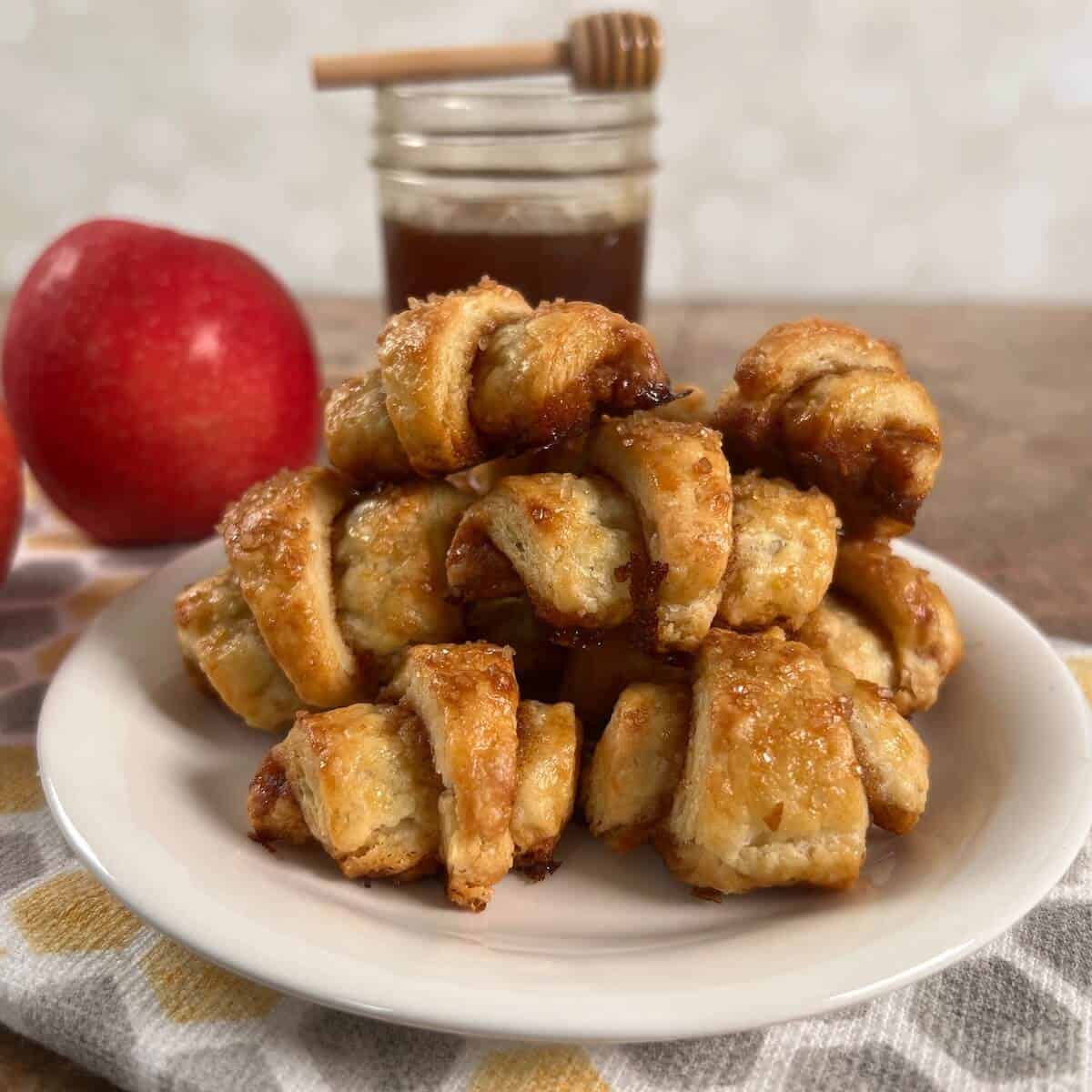
These Apple Cinnamon Rugelach wrap a sweet, warmly spiced boiled apple cider filling in tender, flaky cream cheese pastry. Made with a food processor and easy-to-follow rolling instructions, these little crescent cookies bring plenty of apple flavor to Fall baking and holiday cookie plates!
Jump to:
Quick Recipe Summary ✨
Apple Cinnamon Rugelach: Tender, flaky cream cheese pastry wrapped around a sweet cinnamon-brown sugar filling flavored with concentrated boiled apple cider.
No cooked fruit filling: Boiled cider delivers concentrated apple flavor without chopping or cooking apples. The food processor makes quick work of the dough, with step-by-step instructions to guide you through shaping.
Active Time: 30 minutes • Chill Time: 1 hour 20 minutes • Baking Time: 50 minutes (two 25 minute bakes) • Total Time: 2 hours 40 minutes (mostly hands-off!)
Difficulty Level: ⭐⭐⭐ Medium. The dough is easy to make, with a little patience needed for rolling, filling, and shaping the cookies.
Yield: 32 rugelach cookies • Freezer-friendly: Unbaked cookies up to 6 months • Make-ahead: Dough can be frozen for up to 3 months.
👉 Follow the detailed instructions and troubleshooting tips below to make bakery-quality Apple Cinnamon Rugelach with flaky pastry and delicious apple flavor in every bite!
SUMMARIZE & SAVE THIS CONTENT ON
Why this recipe works
- Rich, flaky pastry: Butter and cream cheese create a tender dough with delicate, flaky layers
- Concentrated apple flavor: Boiled cider delivers sweet-tart apple flavor without making the pastry soggy
- Warm cinnamon sweetness: Brown sugar and cinnamon complement the apple filling with cozy, caramel-like notes
One of the fun things I get to do is teach baking in person. Whether it's for adults or kids, being able to guide people to make their own delicious creations is very gratifying to me.
This Fall I'm leading a 3-part class for 6th graders, and I wanted to create a cookie recipe to use seasonal ingredients. Apples came to mind first, but I didn't want to require chopping, cooking, or draining apples. Then I thought of boiled apple cider (it's a key ingredient in my Apple Spice Cookies) but I wanted something that is in the Jewish culinary tradition.
Rugelach immediately came to mind, and to give them a seasonal twist, I developed the recipe to use the boiled cider with brown sugar and cinnamon rather than chocolate or a fruit spread. Voila, we have Apple Cinnamon Rugelach!
These cookies are easy to make using a classic cream cheese rugelach dough that comes together quickly in a food processor. They're rich, tender, and flaky, and are perfect to snack on or complete a holiday cookie plate.
If 11-year olds can roll out, fill, and bake rugelach, you can, too!
What are rugelach cookies?
Classic rugelach are a rolled crescent-shaped cookie with a sweet filling traditionally associated with Ashkenazi Jewish baking. The fillings can vary from chocolate or other spreads to fruit jams, with or without nuts.
Rugelach differs from hamantaschen cookies (another Jewish filled cookie, this time triangular shaped). Hamantaschen dough, essentially a sugar cookie dough, is designed to hold its shape and stay sturdy around a filling rather than becoming flaky.
In contrast, rugelach have a rich, tender, pastry-like texture with delicate flaky layers. They're made from a rich cream cheese dough of approximately equal weights of flour, butter, and cream cheese in a 1:1:1 recipe ratio. The dough contains little to no sugar (most of the sweetness comes from the filling), and is soft enough to roll thinly without cracking.
Recipe ingredients
You'll need the following ingredients to make this Apple Cinnamon Rugelach recipe:
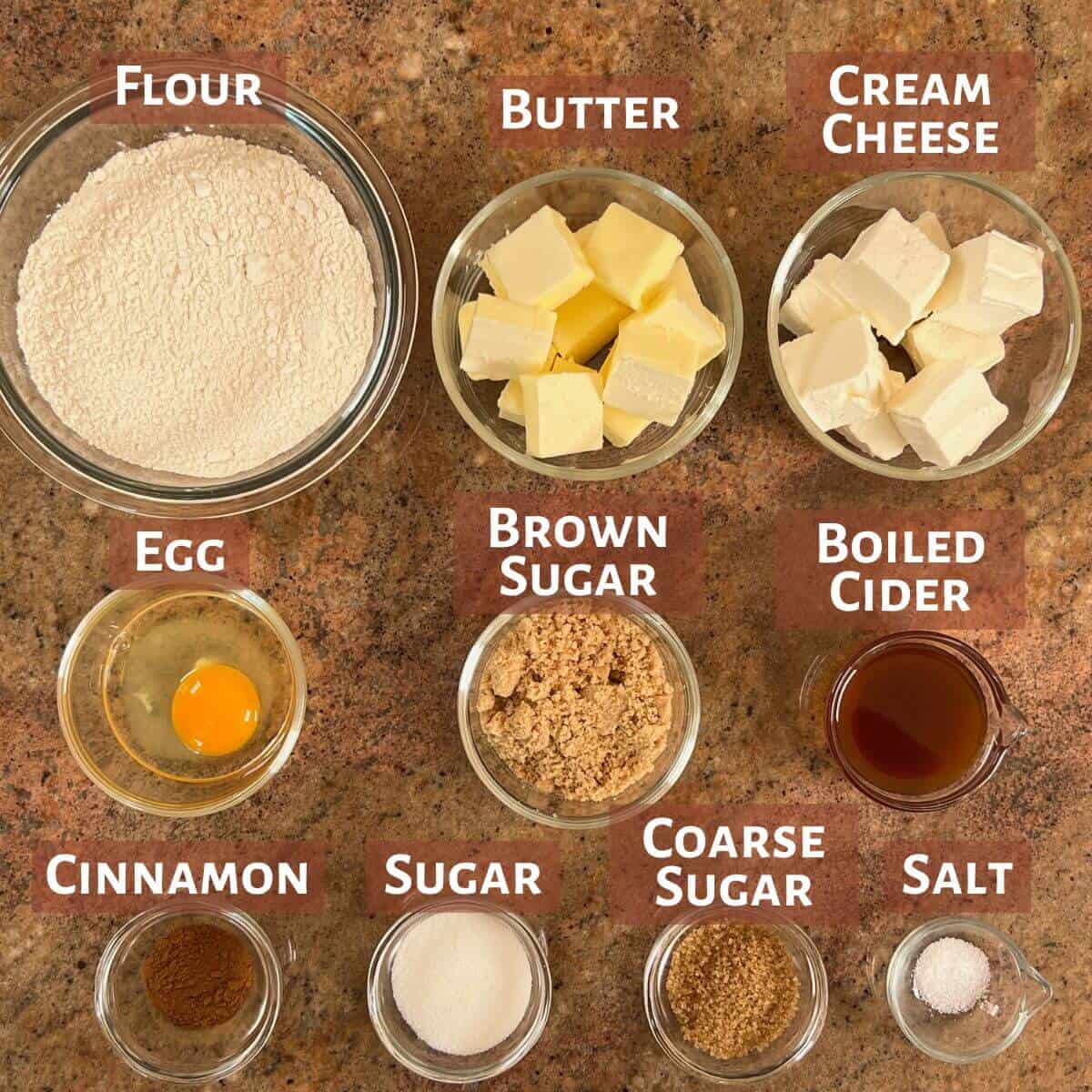
Ingredient Notes
Cream Cheese: Adds richness and flavor to the rugelach dough. Use a full-fat cream cheese for the best texture. When making the dough in a food processor, keep the cream cheese cold until ready to use.
Butter: Like cream cheese, butter adds richness and flavor. And like the cream cheese, keep the butter cold until ready to use.
Boiled Apple Cider: The filling is what differentiates this rugelach from others. In this case, I'm going for a Fall-inspired cookie using boiled apple cider. It's fresh unfiltered apple cider simmered until thick and syrupy, concentrating its sweet-tart apple flavor. Unlike regular cider, a little goes a long way, making it ideal for filling these delicate pastries. You can also use store-bought boiled cider for this recipe.
Brown sugar and cinnamon: These add warm, caramel-like sweetness that complement the concentrated apple flavor. Some of the filling may bubble out during baking, but enough remains inside to give the rugelach their delicious apple-cinnamon flavor.
I use light brown sugar to let the apple flavor shine through - dark brown sugar might overpower the apple with molasses overtones.
Coarse sugar: Adds a bit more sweetness and crunch to the rugelach.
Egg: Unlike with most cookie recipes, the egg isn't used in the dough. Instead it's mixed with a bit of water for an egg wash that's brushed on the rugelach before baking to give a shiny presentation and helps the coarse sugar adhere to the dough.
See the recipe card for a full list of ingredients and measurements.
How to make Apple Cinnamon Rugelach
We're making the dough in 2 batches. This keeps the food processor from becoming overcrowded and helps the ingredients mix evenly.
Step 1: Make the rugelach dough
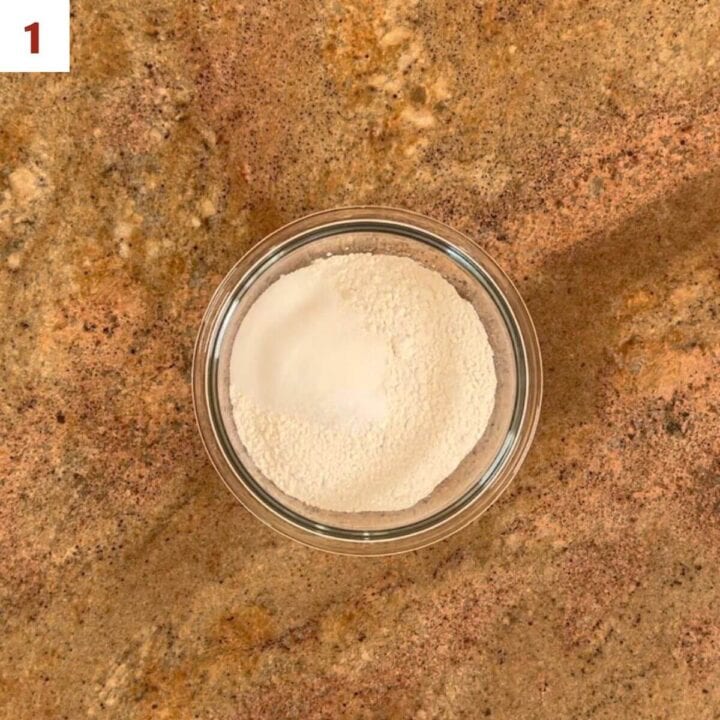
Whisk together half each of the flour, sugar, and salt (photo 1).
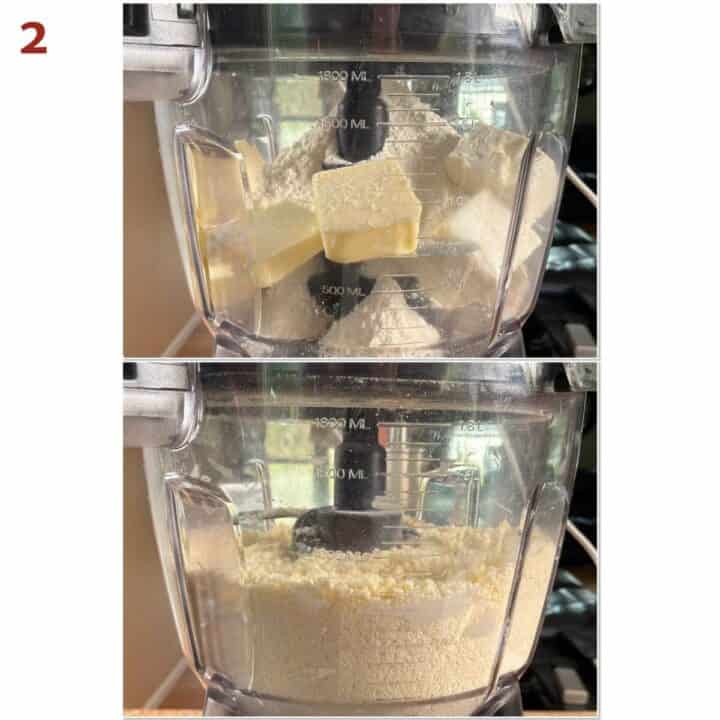
Place half of the cold butter, cream cheese, and the flour mixture in a food processor fitted with the blade attachment.
Pulse 4 to 5 times, then process continuously just until the mixture comes together into a shaggy ball. The result is a soft pastry dough (photo 2).
Don't over-process the dough
Don't continue processing once the dough comes together. Keeping the butter and cream cheese cold helps maintain a lighter, flakier pastry texture.
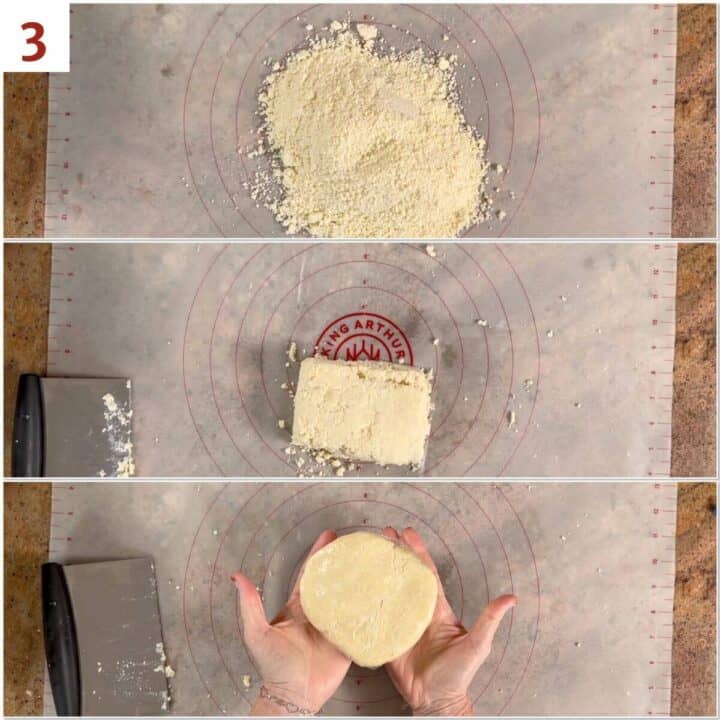
Turn the dough onto a lightly floured surface, gently shape it into a 5-inch disk, smoothing the sides as you go, and wrap with plastic wrap (photo 3). Place in the refrigerator to chill.
Repeat the process with the remaining butter, cream cheese, and flour. Chill both dough disks for at least 1 hour.
Step 2: Prepare the filling
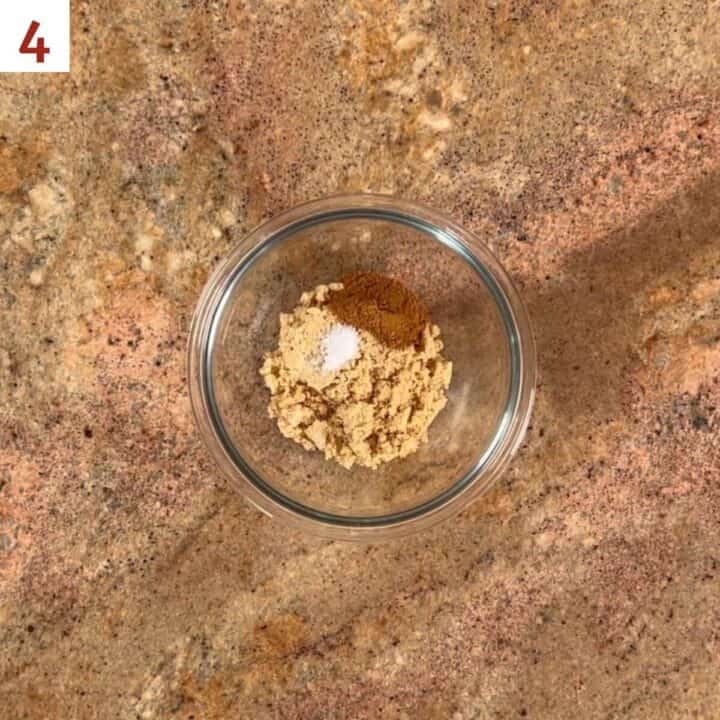
Combine the brown sugar, cinnamon, and salt (photo 4).
Have some boiled apple cider and a pastry brush ready.
Step 3: Assemble the rugelach
Working with one chilled disk at a time, roll the dough on a lightly floured surface into a circle slightly larger than 9 inches, about ⅛-inch thick.
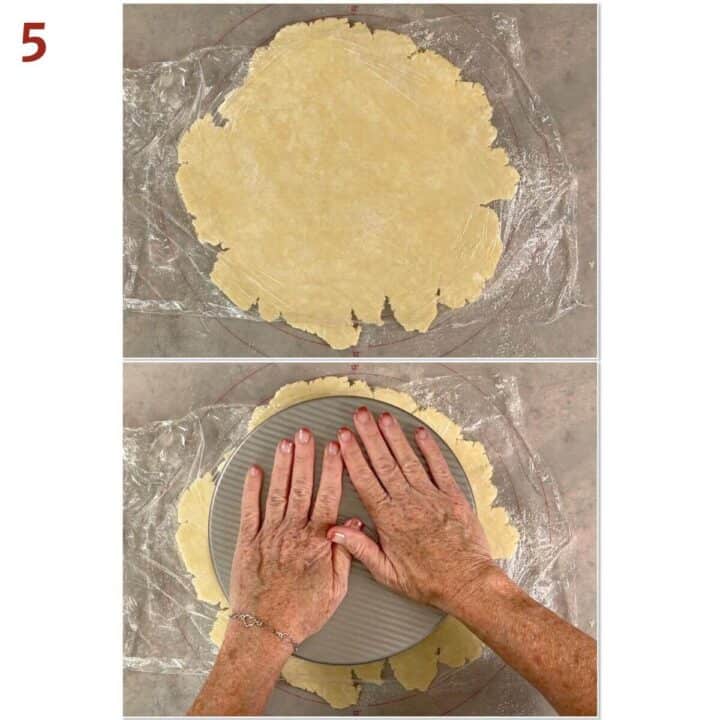
Press a 9-inch round cake pan (or a similarly-sized plate) into the dough and use the indentation as a cutting guide to trim the dough into an even circle using a paring knife (photo 5).
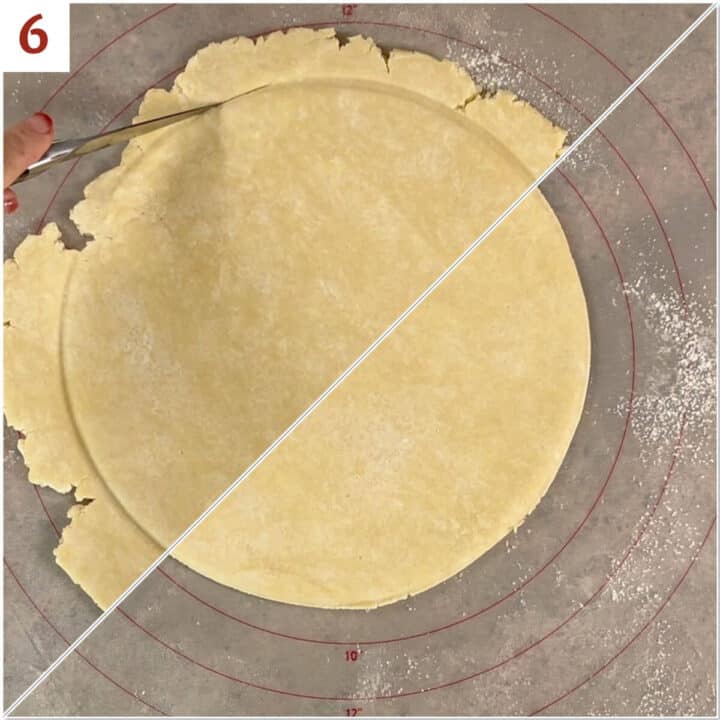
Use a paring knife to cut the dough into an even circle with a smooth edge (photo 6).
Use up the trimmings
Don't toss the dough trimmings! Instead, you can gather the scraps from both circles, gently press them together, and either make a few bonus oddly shaped rugelach or sprinkle them with cinnamon sugar and bake them as pastry scraps.
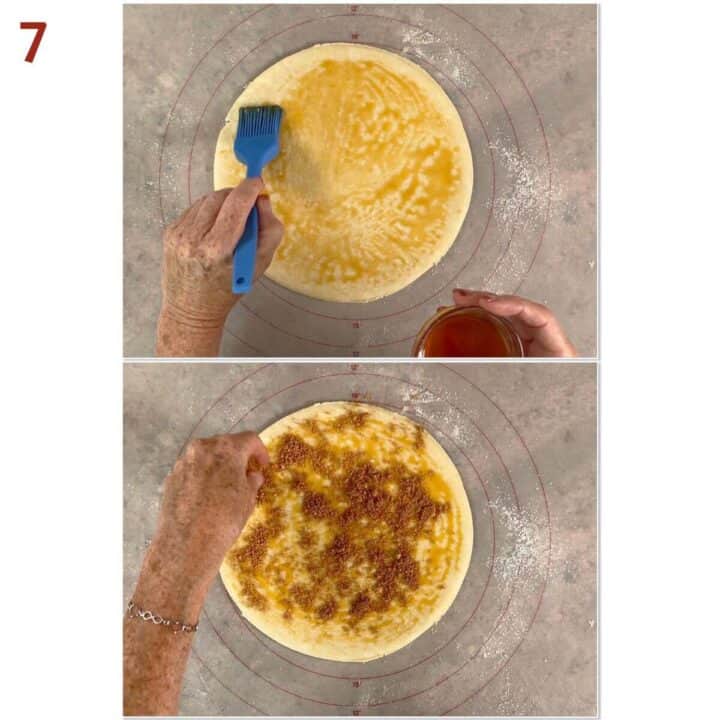
Brush a light coating of boiled apple cider over the dough (about 1 tablespoon), leaving a ¼-inch border around the outer edge. Use a light hand when brushing on the boiled cider - you want the surface lightly coated, not saturated.
Sprinkle half the brown sugar-cinnamon mixture evenly over the boiled cider. Smooth the filling using a small offset spatula (photo 7).
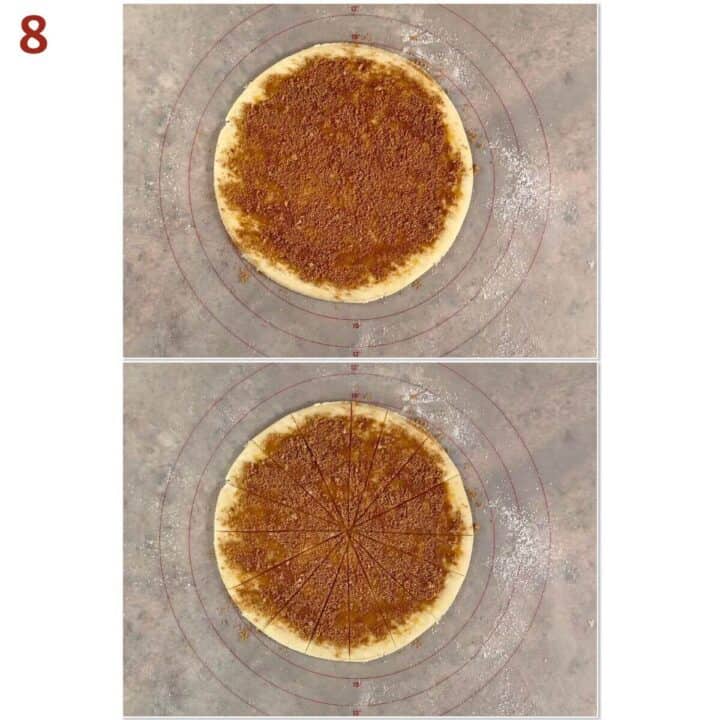
Using a pizza cutter, cut the circle successively into halves, quarters, eighths, then sixteenths (photo 8). You'll have 16 evenly sized wedges.
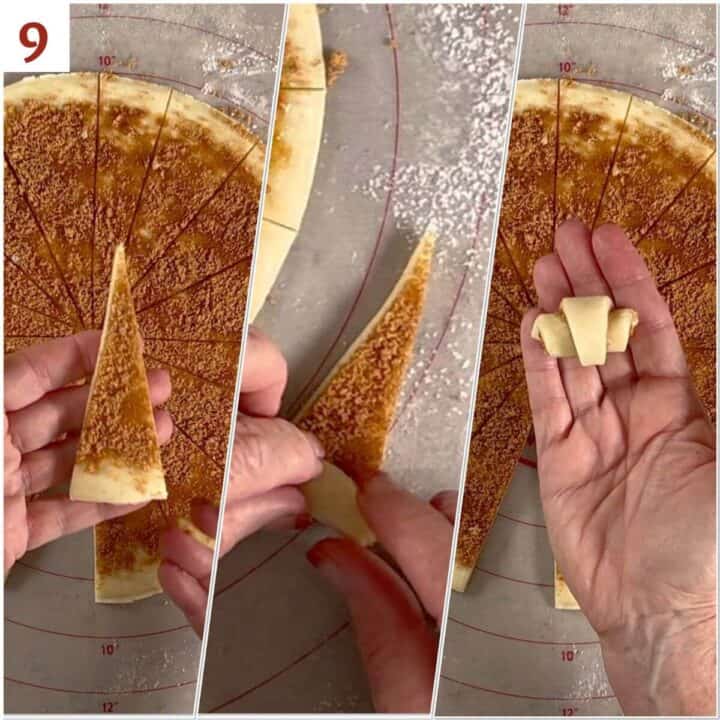
Starting at the wide outer edge of each wedge, roll the dough toward the pointed end to form a small crescent (photo 9).
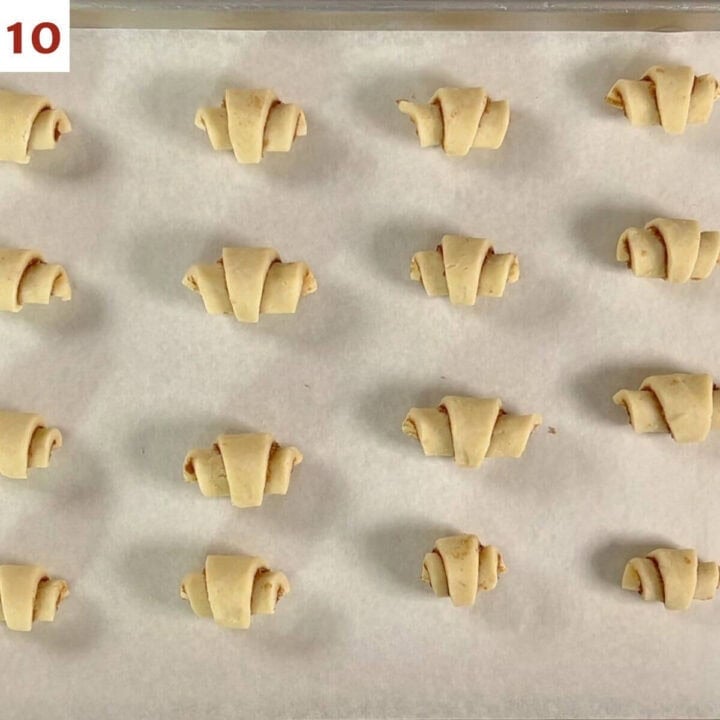
Place the rugelach point-side down on a half sheet baking pan lined with parchment paper and press gently to seal down the point (photo 10).
Place the rugelach in the freezer for at least 20 minutes.
Repeat the rolling, filling, cutting, and shaping with the second disk for 32 rugelach total. You can place the second assembled batch on a parchment-lined large cutting board if you don't have the extra half sheet baking pan. Place the second batch in the freezer for at least 20 minutes.
Bake the rugelach on parchment paper
Stay away from using a silicone mat for this recipe. The parchment makes cleanup from caramelized syrup much easier (it absorbs some of the liquid, allowing for better browning on the bottom of the cookie), and you can simply lift it away from the pan.
Using silicone, the syrup tends to pool, so the bottoms don't brown as well and makes a bigger mess to clean.
Step 4: Bake the rugelach
Brush the rugelach with an egg wash (that is, a beaten egg mixed with a tablespoon of water), then sprinkle with coarse sugar.
Place the parchment-lined baking pan on top of a second half sheet baking pan.
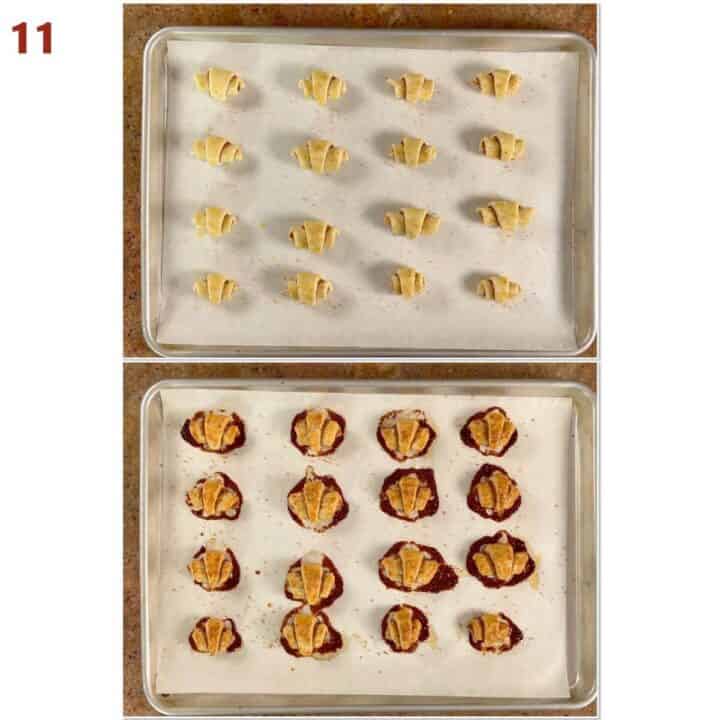
Bake at 375˚F for 22 to 25 minutes or until you have golden-brown pastry with set, lightly browned bottoms (photo 11). Repeat baking with the second batch of rugelach.
Some filling may bubble out during baking. That's expected with the boiled cider filling.
Why use 2 baking pans?
The doubled pans insulate the bottoms of the rugelach from the higher oven heat, preventing scorching even if some filling escapes.
Let the rugelach cool on the baking pan for several minutes. The escaped boiled-cider filling will be extremely hot when it first comes from the oven, so let those caramelized bits cool before handling.
Transfer the rugelach (using the parchment paper as a sling) to a wire rack, and allow to cool completely.
Storage and make-ahead instructions
Storage instructions: Baked rugelach can be stored in an airtight container in layers separated by wax paper, for 3 to 5 days.
Make-ahead instructions: The disks of rugelach dough can be frozen, wrapped in plastic and stored in a freezer-safe bag or container, for up to 3 months. Defrost the dough overnight in the refrigerator before proceeding with shaping.
Individual unbaked rugelach can be frozen while remaining on the baking pan, then stored in a freezer-safe container or bag for up to 6 months. Bake them from frozen as directed - there's no need to defrost them first.
Yield Notes
You get 32 delicious Fall-inspired rugelach from this recipe.
Rugelach dough mixing methods
I like the food processor dough-mixing method because it gives you an advantage by keeping everything cold and minimizing handling, which is particularly useful for this extremely high-fat 1:1:1 dough. However, you can use a stand mixer or a hand mixer to make the rugelach dough if you'd like. The mixer distributes the fat very evenly before the flour goes in, resulting in a dough that's very smooth, tender, and uniform - almost bordering on a very rich cookie pastry.
Here's an at-a-glance comparison of the two methods:
| Food processor | Stand mixer | |
| Butter & cream cheese | Cold | Usually softened |
| Initial action | Cuts fat into flour | Creams fats together |
| Fat distribution | Starts with discrete pieces | Very evenly dispersed |
| Finished texture | More pastry-like/flaky potential | Very tender, smooth, uniform |
| Dough temperature | Stays cooler | Warmer |
| Ease | Extremely fast | Easy, but takes longer |
How to make rugelach dough in a stand mixer
- Let the butter and cream cheese soften to room temperature before starting
- Beat the butter and cream cheese until smooth
- Add the flour mixture and mix on low speed until the dough just comes together
- Shape into disks, wrap with plastic wrap, and refrigerate for 1 hour before assembling the rugelach
Troubleshooting tips
Here are some issues you might encounter when making Apple Cinnamon Rugelach:
- Dough is too sticky to roll: The butter and cream cheese have warmed up. Refrigerate the dough for 15 to 20 minutes until firm but pliable.
- Dough cracks when rolling: It's likely too cold. Let it rest at room temperature for a few minutes, then gently press any cracks together.
- Rugelach lose their shape: The dough may be too warm or the pointed ends aren't tucked underneath. Chill the shaped cookies before baking and place them point-side down.
- Filling leaks during baking: Some bubbling is normal. Use only a thin coating of boiled cider and leave the outer ¼-inch border clear.
- Bottoms brown too quickly: Escaped filling can caramelize and scorch. Use parchment paper and stack two baking pans to moderate the bottom heat.
- Pastry is dense instead of flaky: Over-processing or allowing the dough to get too warm can affect the texture. Process just until the dough comes together and keep it chilled between steps.
Questions asked and answered
Here are some questions you might have...
Like with challah, it's hard to write how to pronounce the word rugelach, but it's roughly pronounced "ROO-guh-lakh." The ending sound doesn't exist in English. The "ch" is the anglicized version for the Hebrew letter "chet" which represents the sound you make when you're trying to clear your throat (like the ending of "Bach"), not the sound starting "cheese."
Regular apple cider is too thin to use directly in the filling and won't provide the same concentrated apple flavor. Instead, simmer unfiltered apple cider without preservatives until it's reduced to a thick, syrupy consistency, or use store-bought boiled cider.
Didn't find the answer you're looking for?
Ask AI to answer for this specific recipe:
Disclaimer: I am not responsible for the quality of AI information

I hope you like this recipe! Let me know if you have any questions, and don't forget to leave a comment and rating. Thanks!
Slainté! L'chaim! Cheers!
- Tammy
Recipe
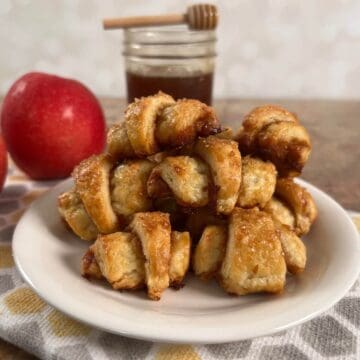
Apple Cinnamon Rugelach with Boiled Cider
Equipment
- food processor fitted with the blade attachment
- rolling pin
- 9-inch round cake pan or a similarly-sized plate, for a cutting guide
- paring knife
- 3 half sheet baking pans or 2 baking pans and a large cutting board.
Ingredients
For the cream cheese pastry dough
- 2 cups all-purpose flour, divided
- 2 tablespoons granulated sugar, divided
- ¼ teaspoon kosher salt, divided
- 1 cup unsalted butter, cold, divided, see Recipe Notes
- 1 cup cream cheese, cold, divided, see Recipe Notes
For the boiled apple cider filling
- 4 tablespoons light brown sugar, packed
- 1 teaspoon ground cinnamon
- ⅛ teaspoon kosher salt
- 2 tablespoons boiled apple cider, or as needed, homemade or store-bought
For finishing
- 1 large egg
- 1 tablespoon water
- coarse sugar, for sprinkling
Instructions
- Make the first dough disk: Whisk together 1 cup all-purpose flour , 1 tablespoon granulated sugar, ⅛ teaspoon kosher salt in a small bowl.Transfer the flour mixture to the bowl of a food processor.
- Add ½ cup unsalted butter and ½ cup cream cheese to the food processor bowl.
- Pulse 4 to 5 times, then process continuously just until the mixture comes together into a shaggy ball (less than 30 seconds). Don't continue processing once the dough comes together - you should get a soft pastry dough.
- Turn the dough onto a lightly floured surface, gently shape it into a 5-inch disk, smoothing the sides as you go, and wrap with plastic wrap. Place in the refrigerator.
- Make the second disk: Whisk together the remaining 1 cup all-purpose flour, 1 tablespoon granulated sugar, and ⅛ teaspoon kosher salt, and transfer to the food processor.Add the remaining ½ cup unsalted butter, ½ cup cream cheese, and process as described above. Shape the dough into a disk, wrap with plastic, and refrigerate.
- Refrigerate both disks for 1 hour to let the butter and cream cheese firm up.
- Prepare the filling: While the dough chills, combine 4 tablespoons light brown sugar, 1 teaspoon ground cinnamon, and ⅛ teaspoon kosher salt, breaking up any lumps in the brown sugar.Have about 2 tablespoons boiled apple cider and a pastry brush ready.
- Assemble the rugelach: Working with one chilled disk at a time, roll the dough on a lightly floured surface into a circle slightly larger than 9 inches, about ⅛-inch thick. Press a 9-inch round cake pan (or a similarly-sized plate) into the dough and use the indentation as a cutting guide to trim the dough into an even circle using a paring knife.
- Brush a light coating of boiled apple cider over the dough, leaving a ¼-inch border around the outer edge (see Recipe Notes). Sprinkle half the brown sugar-cinnamon mixture evenly over the boiled cider. Smooth the filling using a small offset spatula.
- Using a pizza cutter, cut the circle successively into halves, quarters, eighths, then sixteenths. You'll have 16 evenly sized wedges.
- Starting at the wide outer edge of each wedge, roll the dough toward the pointed end to form a small crescent. Place the rugelach point-side down on a half sheet baking pan lined with parchment paper and press gently to seal down the point. Place in the freezer for at least 20 minutes
- Repeat the rolling, filling, cutting, and shaping with the second disk for 32 rugelach total. You can place the second assembled batch on a parchment-lined large cutting board if you don't have the extra half sheet baking pan. Place the second batch in the freezer for at least 20 minutes.
- Adjust oven rack to middle position and preheat the oven to 375°F. Beat 1 large egg with 1 tablespoon water.
- Bake the rugelach: Remove the first batch of rugelach from the freezer and brush each lightly with the egg wash. Sprinkle with coarse sugar.
- Place the parchment-lined baking pan on top of a second half sheet baking pan. The doubled pans insulate the bottoms from the higher oven heat, preventing scorching even if some filling escapes.
- Bake for 22 to 25 minutes, or until you have golden-brown pastry with set, lightly browned bottoms. Some filling may bubble out during baking - that's expected with the boiled cider filling. Repeat the baking with the second batch of rugelach.
- Let the rugelach cool on the baking pan for several minutes. The escaped boiled-cider filling will be extremely hot when it first comes from the oven, so let those caramelized bits cool before handling.Transfer the rugelach (using the parchment paper as a sling) to a wire rack, and allow to cool completely.
- Storage information: Baked rugelach can be stored in an airtight container in layers separated by wax paper, for 3 to 5 days. They can also be stored in the freezer in an airtight container for up to 6 months.
- Make-ahead instructions: The disks of rugelach dough can be frozen, wrapped in plastic and stored in a freezer-safe bag or container, for up to 3 months. Defrost the dough overnight in the refrigerator before proceeding with shaping.Individual unbaked rugelach can be frozen on the baking pan, then stored in a freezer-safe container or bag for up to 6 months. Bake them from frozen as directed - there's no need to defrost them first.
Notes
- Let the butter and cream cheese soften to room temperature before starting
- Beat the butter and cream cheese until smooth
- Add the flour mixture and mix on low speed until the dough just comes together
- Shape into disks, wrap with plastic wrap, and refrigerate for 1 hour before assembling the rugelach




Tammy Spencer says
I enjoyed creating this recipe for you, and I hope you like it as much as I do. Please leave your questions or comments with a star rating so that other readers can benefit from your experience. Thanks!