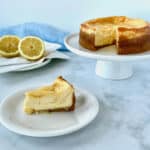
Lemon Curd Cheesecake
Delightfully lemony and super creamy, this baked lemon curd cheesecake is sure to please. While this mini cheesecake is perfect for portion control, you'll get big flavor in every bite!
Servings: 8 slices
Calories: 337kcal
Special Equipment
- large roasting pan or 9- x 13-inch baking pan
Ingredients
For the crust
- ½ recipe (½ recipe) graham cracker pie crust, see Recipe Notes
For the filling
- 1½ cups (341 grams) cream cheese, full fat, at room temperature, see Recipe Notes (1½ blocks)
- ½ cup (100 grams) granulated sugar
- ¼ cup (58 grams) sour cream, full fat, at room temperature, see Recipe Notes
- 1 teaspoon (1 teaspoon) vanilla extract
- 2 (100 grams) large eggs, at room temperature, see Recipe Notes
- 1 tablespoon (14 grams) unsalted butter, melted
- ½ cup (113 grams) lemon curd, homemade or store bought
Instructions
- Adjust the oven rack to the lower third position and preheat the oven to 350 °F.
- Check to see if your 6-inch round springform pan fits in a large roasting pan (to use for the water bath). Don't worry if your roasting pan isn't big enough, just use a 9- x 13-in roasting pan to create steam (see water bath instructions below).
- Make the crust: Prepare ½ recipe graham cracker pie crust and press into the 6-inch round springform pan (you don't have to grease the pan first). Use a pastry tart tamper, the bottom of a measuring cup, or a straight sided glass tumbler to pack the crust down tightly.
- Bake the crust for 10 minutes, then remove the pan from oven and cool completely. Reduce the oven temperature to oven to 325 °F.
- Make the filling: Using a stand mixer fitted with a paddle attachment or a hand mixer, beat 1½ cups cream cheese and ½ cup granulated sugar together on medium-high speed in a large bowl until the mixture is smooth and creamy, about 2 minutes. Add ¼ cup sour cream and 1 teaspoon vanilla extract, then beat until fully combined.
- On medium speed, add 2 large eggs, one at a time, beating after each addition until just blended. After the final egg is incorporated into the batter, stop mixing. You don't want to over-beat the mixture to help prevent the cheesecake from deflating and cracking as it cools.
- Before adding the cheesecake batter to the cooled crust, use a pastry brush to spread 1 tablespoon unsalted butter (melted) on the inside of the pan from the top of the crust to the top edge. This helps keep any batter that rises above the crust from sticking to the pan.
- Pour ⅔ of the filling into the cooled crust, then spoon half of the ½ cup lemon curd over the filling. Swirl the curd into the filling with a small knife (avoid touching crust with knife to prevent crumbs getting into filling). Repeat with the remaining filling and lemon curd. Tap the pan gently on the counter to release any trapped air bubbles.
- Prepare the water bath: If you have a roasting pan large enough to fit your springform pan, wrap the outside of the springform pan in a double layer of foil, covering the bottom and extending all the way to the top (although a good crust keeps filling from leaking out, the foil helps protect against water leaking in). Set the wrapped cheesecake in the large roasting pan, and carefully pour hot water into the roasting pan until it reaches halfway up the sides of the cheesecake (about 2 inches). Carefully transfer the roasting pan to the lower third rack in the oven.
- If you don't have a roasting pan large enough to fit your springform pan, place a 9- x 13-inch baking pan at the bottom of the oven (or the lowest shelf). Pour in enough hot water to reach halfway up the sides of the pan. This creates the steam to simulate the water bath. Put the cheesecake on the lower-third rack directly above the water-filled pan.
- Continuing: Bake the cheesecake for 50 to 55 minutes or until the center is almost set. If you notice the cheesecake browning too quickly on top, tent it with aluminum foil halfway through the baking time. When it's done, the center of the cheesecake will slightly wobble if you gently shake the pan.
- Turn the oven off and open the oven door slightly. Let the cheesecake sit in the oven (with the water bath) as it cools down for 1 hour. This allows the cheesecake to avoid sudden temperature changes, again keeping it from cracking. Remove the cheesecake from the oven, then cool it completely at room temperature.
- Refrigerate the cheesecake for at least 4 hours or overnight. Use a knife to loosen the chilled cheesecake from the rim of the springform pan, then remove the rim.
- Cut the cheesecake into slices with a sharp knife, wiping the knife and dipping it into warm water between each cut to get nice, neat slices.
- Storage instructions: Cheesecake can be stored, covered, in the refrigerator for up to 5 days.
- Make-ahead instructions: Lemon curd can be stored in an airtight container, like a canning jar, in the refrigerator for 3 to 4 weeks, and in the freezer for up to 1 year. Thaw overnight in the refrigerator before using.Cooled graham cracker crusts can be stored tightly wrapped with plastic wrap in the refrigerator for 3 days, or in the freezer for 3 months.The cheesecake itself is best made the day before you want to serve it since it has to chill for quite some time.Another way to make this cheesecake ahead of time is to freeze it - it can be frozen for up to 3 months. Here's a helpful tutorial for freezing cheesecakes. When you're ready to serve, thaw it overnight in the refrigerator before serving.
Recipe Notes
Baking the graham cracker crust sets it and keeps it from getting soggy or shifting when the cheesecake batter is added. Let the crust cool completely before adding the filling.
Now isn’t the time for reduced fat or nonfat cream cheese or sour cream - they contain fillers that might prevent the cheesecake from setting properly. Also, never substitute whipped cream cheese for the solid block (you don't want that extra air).
It’s important to bring all the cold ingredients to room temperature before beginning. They’ll combine quickly and evenly so you won’t risk over-mixing the batter. Beating cold ingredients together will result in a chunky cheesecake batter, and who wants that?
To help prevent the cheesecake from deflating and cracking as it cools, avoid over-mixing the batter as best you can, especially when adding in the eggs. You don’t want air beaten into the eggs because it causes them to inflate while baking, then deflate when cooled. This can crack the cheesecake or form bubbles on the surface.
To make a full-sized cheesecake, just double the ingredient amounts and bake in a 9-inch round springform pan for 55 to 70 minutes.
Nutrition
Serving: 1slice | Calories: 337kcal | Carbohydrates: 35g | Protein: 5g | Fat: 19g | Saturated Fat: 11g | Polyunsaturated Fat: 1g | Monounsaturated Fat: 4g | Trans Fat: 1g | Cholesterol: 92mg | Sodium: 277mg | Potassium: 112mg | Fiber: 1g | Sugar: 30g | Vitamin A: 686IU | Vitamin C: 1mg | Calcium: 71mg | Iron: 1mg
Scan the QR code to find the online recipe or visit us at www.scotchandscones.com