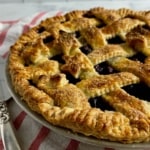
How to Make 3:2:1 Pie Crust
An all butter pie crust is flaky, tender, and easy to make, especially if you remember its 3 : 2 : 1 recipe ratio of flour, butter, and water, by weight. Scale the recipe for a single or double crust, and learn to how to blind bake your pie crust without pie weights. There's lots to know, and it's all here!
Servings: 12 slices
Calories: 125kcal
Special Equipment
- rolling pin
Ingredients
For a double crust pie
- 2¾ cups (330 grams) all-purpose flour
- 2 to 3 tablespoons (30 grams) granulated sugar, if making a sweet pie (optional)
- 1 teaspoon (1 teaspoon) kosher salt
- 1 cup (227 grams) unsalted butter, cold, grated or cubed, see Recipe Notes
- ½ cup (114 grams) ice water
- 1 tablespoon (15 grams) apple cider vinegar, white vinegar, or lemon juice, chilled
Instructions
- Make the dough: Measure your ingredients using a kitchen scale. It's the most accurate and will give the most consistent results.Note: The instructions below are for making the dough by hand. If you want to use the food processor to make the dough, see the instructions in the post above.
- In a large bowl, stir together 2¾ cups all-purpose flour, 2 to 3 tablespoons granulated sugar (if using), and 1 teaspoon kosher salt.
- Toss 1 cup unsalted butter (grated or cubed) into the flour mixture to coat, then use a pastry blender, two forks, or your hands to work the butter into the flour mixture until coarse, pea-sized crumbs appear. Don't overdo this step as you don't want the butter to warm up and mix completely into the flour.
- In a small bowl, whisk together ½ cup ice water with 1 tablespoon apple cider vinegar vinegar or lemon juice.
- Slowly add the water mixture to the flour mixture and mix until the dough just holds together. Using a bowl scraper will help to combine the dough in the bowl without your hands warming up the butter, plus you can see any crumbs at the bottom that still need to be mixed in. Remember, do not over mix the dough - you want to keep that butter cold and separate from the flour.
- The amount of liquid to add to the flour mixture depends on the humidity of the day. Squeeze a small amount of dough between your fingers. If it is very crumbly, add 1 to 2 tablespoons ice water or flour, 1 tablespoon at a time (2 tablespoons maximum).Don't worry if the dough has a slight lemony or vinegary smell. That will dissipate during baking and/or be overwhelmed by the filling.
- Turn the dough out onto a lightly floured surface and push together into a rough ball. Knead a few times to combine, then divide into two equal balls. Flatten each ball into a disk with smooth edges (no cracks), cover with plastic wrap, and refrigerate at least 1 hour or up to overnight.
- Roll out the dough: Lightly dust your rolling surface with flour. Use even pressure to roll the dough out front to back and on the diagonals. Turn and loosen the dough occasionally as you continue to roll the pastry out into a circle about 2 to 3 inches larger than your pan with a thickness of approximately ¼-inch (about the height of two stacked quarters), unless otherwise directed by your recipe.
- Transfer the dough to the pie pan you're using. Ease the crust into the pan, pressing up on the sides and leaving the dough overhanging the rim.
- For a single crust pie: Trim the overhang to 1-inch, then turn the overhang inward and crimp as desired. For a double crust pie: Trim the overhang to ½-inch. Roll out the second disk to the same dimensions and chill until needed.
- Continuing: Save the dough scraps to repair the crust later if needed. Prick the bottom all over with a fork, then chill the pie shell until you're ready to fill the pie.
- To blind bake the crust: If your recipe calls for a par-baked or blind-baked pie crust, preheat the oven to 375 °F. Prick the bottom of the pie shell all over with a fork.
- Tear off a piece of foil that fits over the entire pan with overhang (or add extra foil as needed). Spray the foil with baking spray to keep it from sticking to the dough. Press the foil into the pan and tightly up against the sides. Bring the foil up over the rim and mold it to the sides of the pan. Freeze the crust for 15 minutes. You don't need to use pie weights or dried beans using this frozen-foil method.
- Bake the crust with the foil on for 20 minutes. At this point the crust is par-baked.
- Carefully remove the foil from the crust. If the crust has puffed up, gently press it back down. Any tears or cracks in the crust can be repaired with dough scraps. Return the crust to the oven and bake the crust until golden brown, 5 to 10 minutes more.
- The crust is now ready to be filled and baked as desired.
- Storage instructions: Pie crust dough can be frozen after being portioned into disks. Wrap each disk with plastic wrap and store in an airtight plastic bag. When you're ready to use it, defrost the dough overnight in the refrigerator. Allow the dough to sit out on the counter a few minutes to warm slightly before proceeding with rolling out the dough.
- This double crust recipe makes enough crust for a 9-inch pie pan. See the Recipe Notes for how to make a dough for a 9-inch single crust pie. Remember, you can scale the recipe up or down as needed using the 3 : 2 : 1 recipe ratio!
Recipe Notes
How you cut up your butter isn't as important as keeping it cold. Either grate frozen butter on a box grater, or cut the chilled butter into small ½-inch cubes. Either way will work.
You have to be flexible about the amount of liquid to add to the flour mixture as the actual amount will depend on the humidity of the day. Squeeze a small amount of dough between your fingers and if it is very crumbly, add more liquid, 1 tablespoon at a time (2 tablespoons maximum). If the dough is too wet, you can knead in 1 tablespoon of flour when you turn out the dough. Don't over-mix the dough - you want to keep that butter cold and separate from the flour.
For a 9-inch single crust pie, use the 9-6-3 ratio: 9 ounces flour (250 grams), 6 ounces butter (170 grams), and 3 ounces water (85 grams). In volume measurements, that's 2 cups flour, 1½ cups butter, and ⅓ cup water. Reduce the salt to ½ teaspoon, the sugar to 1½ tablespoons (if using), and the apple cider vinegar to 2 teaspoons.
You can use other fats rather than just butter when making your pie crust recipe. It could be all one type or a combination of butter, vegetable shortening (like Crisco), lard (many people's choice), or something else entirely. I've seen recipes with coconut oil (to make it vegan), and I've used rendered beef or chicken fat on occasion (for savory pies). The choice is yours.
Nutrition
Serving: 1slice | Calories: 125kcal | Carbohydrates: 25g | Protein: 4g | Fat: 1g | Saturated Fat: 1g | Cholesterol: 2mg | Sodium: 216mg | Potassium: 58mg | Fiber: 1g | Sugar: 3g | Vitamin A: 33IU | Calcium: 27mg | Iron: 1mg
Scan the QR code to find the online recipe or visit us at www.scotchandscones.com