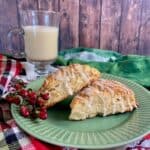
Glazed Spiced Eggnog Scones
If you love the taste of eggnog, you'll love the taste of these Eggnog Scones topped with an eggnog glaze and sprinkled with nutmeg. The eggnog flavor is subtle and creamy with a hint of nutmeg spice. They're perfect for your holiday brunch and make a great hostess gift!
Servings: 8 scones
Calories: 376kcal
Special Equipment
Ingredients
For the scones
- 2¼ cups (270 grams) all-purpose flour
- 2 tablespoons (2 tablespoon) granulated sugar
- 1 tablespoon (1 tablespoon) baking powder
- ¾ teaspoon (¾ teaspoon) ground nutmeg
- ½ teaspoon (½ teaspoon) kosher salt
- ½ cup (114 grams) unsalted butter, cold, grated or cubed, see Recipe Notes
- ⅓ cup (85 grams) eggnog, homemade or store bought, see Recipe Notes
- 1 (50 grams) large egg
- ¼ cup (58 grams) heavy cream
- ½ teaspoon (½ teaspoon) pure vanilla extract
For the topping
- 1 tablespoon (15 grams) eggnog
- 1 tablespoon (15 grams) coarse sugar
For the glaze
- 1 cup (113 grams) powdered sugar, sifted
- 2 tablespoons (30 grams) eggnog
- ½ teaspoon (½ teaspoon) pure vanilla extract
- ground nutmeg, for dusting
Instructions
- For the scones: Preheat the oven to 425 °F.Note: The instructions below are for making the dough by hand. If you want to use the food processor to make the dough, see the instructions in the post above.
- In a large mixing bowl, combine 2¼ cups all-purpose flour, 2 tablespoons granulated sugar, 1 tablespoon baking powder, ¾ teaspoon ground nutmeg, and ½ teaspoon kosher salt.
- Toss the ½ cup unsalted butter into the flour mixture to coat, then use a pastry blender, two forks, or your hands to work the butter into the flour mixture until coarse, pea-sized crumbs appear. Don't overdo this step as you don't want the butter to warm up and mix completely into the flour.
- In a separate bowl, whisk together ⅓ cup eggnog, 1 large egg, ¼ cup heavy cream, and ½ teaspoon pure vanilla extract.
- Slowly add the eggnog mixture to the flour mixture and mix until the dough just holds together. Using a bowl scraper will help to combine the dough in the bowl without your hands warming up the butter, plus you can see any crumbs at the bottom that still need to be mixed in. Remember, do not over mix the dough - you want to keep that butter cold and separate from the flour.The amount of liquid to add to the flour mixture depends on the humidity of the day. Squeeze a small amount of dough between your fingers, and add more heavy cream or flour, 1 tablespoon at a time (2 tablespoons maximum), if it's too crumbly or too wet.
- Gather the dough, and flatten it into a 6-inch disk (if you want square scones, shape the dough into a rectangle with the short side about 4-inches long). Use a bench scraper to release the dough, if needed. Cover with plastic wrap, and refrigerate the dough at least 30 minutes or up to overnight.
- Once the dough is chilled, you have your choice of how to shape the scones:For wedge-shaped scones: Roll out the disk into an 8-inch circle, then use the bench scraper to cut the disk into 8 wedges. For round scones: Roll out the disk to a height of about ¾ inches. Use a 3-inch round cookie cutter to cut out rounds (gather, press, and cut the leftover dough again as needed, but hopefully not more than 2 times).For square scones: Roll out the dough into a 12- by 4-inch rectangle, then cut into twelve 2-inch squares.
- Place the scones about 2-inches apart on the prepared baking pan. Brush the tops of the scones with 1 tablespoon eggnog, then sprinkle with 1 tablespoon coarse sugar.
- Bake the scones for 18 to 23 minutes or until they are golden brown. If you're going to glaze the scones, allow them cool for 15 minutes before continuing.
- For the glaze: In a small bowl, mix together t1 cup powdered sugar, 2 tablespoons eggnog, and ½ teaspoon pure vanilla extract. Keep adding the eggnog in one tablespoon increments until smooth glaze is smooth and thick.
- Drizzle the glaze generously over the scones. Dust them with ground nutmeg, then allow the glaze to set before serving.
- Storage Instructions: Scones are best enjoyed right away, though leftover scones keep well at room temperature or in the refrigerator for about 3 to 5 days. Glazed or plain scones freeze well, up to 3 months. Thaw overnight in the refrigerator then warm to your liking before enjoying.
- Make-ahead instructions: For freshly baked scones anytime, freeze the cut, unbaked scones in a ziplock bag. Take out as many as you want to bake (there's no need to defrost them first), and bake at 400 °F for 20 to 25 minutes.
- The yield is generally about 8 scones (that's what I get from a disk cut into wedges or using a 3-inch round cookie cutter), but yours may vary.
Recipe Notes
How you cut up your butter isn't as important as keeping it cold. Generally I'll grate frozen butter on a box grater (mostly because I don't have butter defrosted). If you'd rather, cut chilled butter into small ½-inch cubes. Either way will work.
Homemade eggnog made in the blender is quick and easy to make. Just combine all the eggnog ingredients in a blender, pulse a few times, and you're ready to roll! And it's safe for those that don't eat raw eggs since you'll be baking the egg yolks. It's your choice whether to spike it or not. Alternatively, commercially made eggnog is fine for an eggnog scones recipe, and you can use a dairy-free eggnog if you wish.
However, be aware that homemade eggnog used for the glaze isn't cooked, so any raw egg yolks and alcohol will still be there. Don't use the glaze if you'll be serving children or pregnant women.
Nutrition
Serving: 1scone | Calories: 376kcal | Carbohydrates: 49g | Protein: 6g | Fat: 18g | Saturated Fat: 11g | Polyunsaturated Fat: 1g | Monounsaturated Fat: 4g | Trans Fat: 1g | Cholesterol: 88mg | Sodium: 325mg | Potassium: 79mg | Fiber: 1g | Sugar: 22g | Vitamin A: 590IU | Vitamin C: 1mg | Calcium: 121mg | Iron: 2mg
Scan the QR code to find the online recipe or visit us at www.scotchandscones.com